Opening Statement
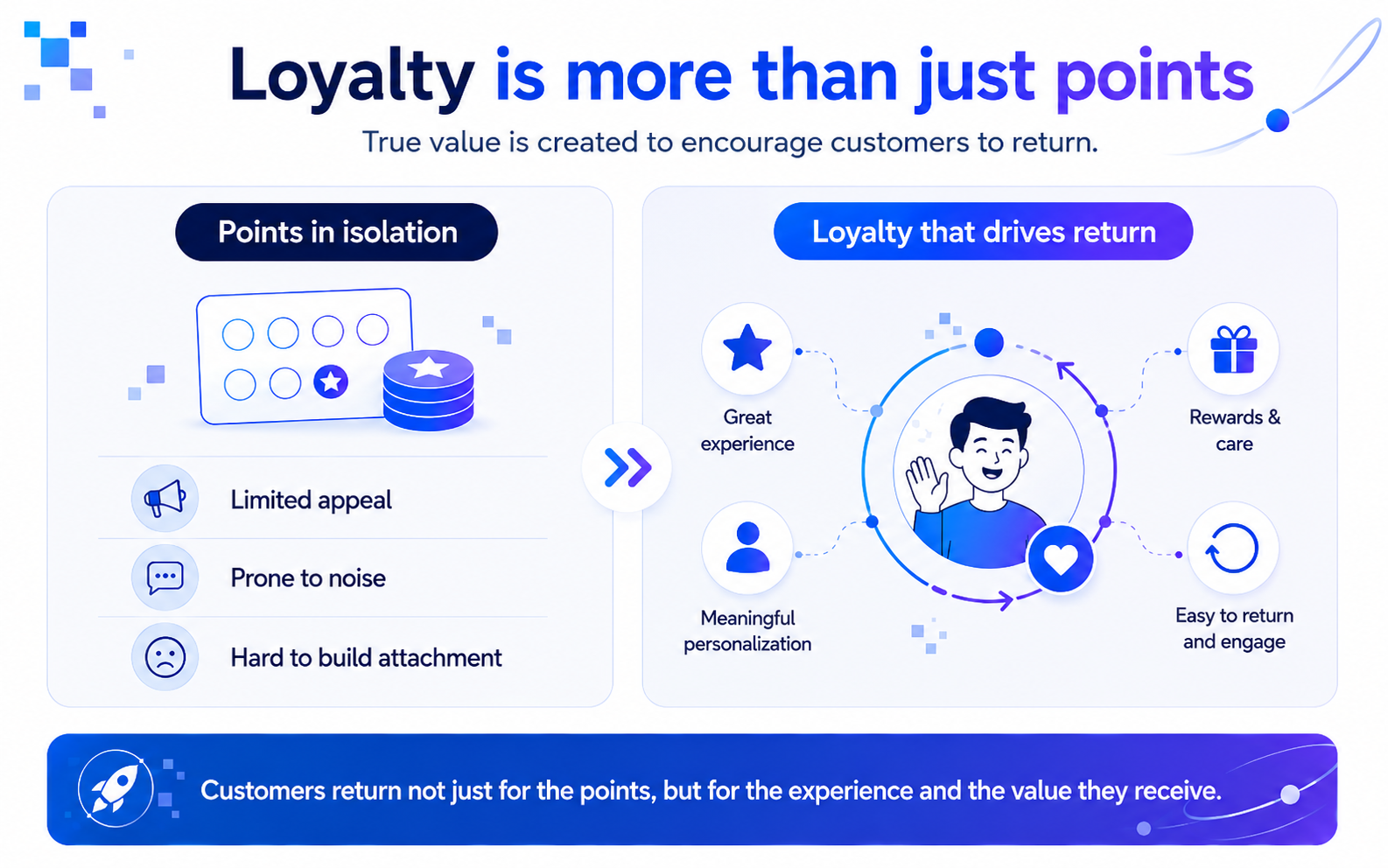
When discussing loyalty, many businesses immediately think of point systems, membership tiers, discount codes, birthday vouchers, or reward redemption programs. While these elements can be useful, loyalty is not merely a rewards mechanism.
A customer might collect points but remain unloyal. They might receive discounts but still purchase elsewhere if the experience is superior. They might be a registered member but rarely return. They might receive care emails but never feel the brand truly understands them.
True loyalty does not stem from a name in a membership system; it comes from the customer having a reason to return. That reason could be product value, an excellent experience, convenience, a feeling of being understood, post-purchase support, relevant offers, community engagement, or brand trust.
Why is this important?
The cost of acquiring new customers is almost always higher than retaining existing ones. However, retention is not just about sending more discounts. If a business relies solely on price cuts to pull customers back, they become conditioned to discounts and will easily switch to a competitor offering a better deal.
Sustainable loyalty requires depth:
-
Customers feel the product is a perfect fit.
-
The purchasing and post-purchase experience is pleasant.
-
The brand remembers interaction history.
-
Care messages are sent at the right time.
-
Offers are tailored to specific needs.
-
Customers are recognized based on the value of the relationship.
-
The business handles issues effectively when problems arise.
Loyalty is not a standalone program; it is the outcome of the entire customer experience.
What is changing?
1. Customers have more choices In almost every industry, customers have an abundance of options. They compare prices, check reviews, purchase across multiple channels, and switch brands rapidly. This makes loyalty harder to achieve; businesses cannot rely on old buying habits alone. You must create a clearer reason to return.
2. Mass offers are becoming less effective Not every customer needs the same offer. New customers need a reason to try; first-time buyers need post-purchase care; repeat buyers need recognition; silent customers need a reason to reactivate; and high-value customers need a differentiated experience. Loyalty must be data-driven and segmented, rather than sending the same voucher to everyone.
3. CRM and data empower smarter loyalty With CRM and behavioral data, businesses can understand what customers bought, when they bought it, how they reacted, which product categories they care about, and how long they have been silent. This data allows businesses to design loyalty within context. Good loyalty doesn’t just ask, “How should we reward the customer?” but “What reason does the customer need to return right now?”
The Digiverse Perspective
At Digiverse, we believe loyalty should be built upon five layers:
-
Core Experience: There is no sustainable loyalty if the product or service fails to meet expectations.
-
Clear Customer Data: Businesses must know what customers purchase, how they interact, and their current status.
-
Segmentation by Value & Behavior: Do not treat every customer the same.
-
Relevant Reasons to Return: Reasons can include offers, useful content, superior service, membership benefits, or personalized experiences.
-
Measuring Long-term Value: Loyalty must be measured by repurchases, frequency, customer value, churn rates, and satisfaction levels.
Implementation Framework: 6 Steps to Practical Loyalty
-
Step 1: Understand why customers return. Find out if customers return for price, quality, convenience, service, trust, incentives, or experience. Do not assume everyone returns for points.
-
Step 2: Segment customers by behavior. Categorize into new customers, first-time buyers, repeat buyers, high-value customers, silent customers, and those at risk of churn. Each group needs a distinct care approach.
-
Step 3: Design benefits based on relationship value. Benefits shouldn’t just be discounts. Consider priority consulting, exclusive content, faster service, special experiences, personalized gifts, early access, or dedicated account management. The more relevant the benefit, the more valuable the loyalty.
-
Step 4: Trigger care at the right time. New buyers need usage instructions. First-time buyers need encouragement to return. The long-term silent need a reason to reactivate. High-value customers need to be recognized. Timing is as important as content.
-
Step 5: Connect loyalty to CRM. The CRM must record membership status, purchase history, feedback, benefits received, and next steps in the care journey. Without CRM integration, programs easily become generic mass promotions.
-
Step 6: Measure loyalty via long-term value. Track repurchase rates, frequency, Customer Lifetime Value (CLV), churn rates, benefit utilization, and customer feedback. Loyalty only has meaning when it strengthens the customer relationship.
Implications for Vietnamese Businesses
In Vietnam, many businesses have membership programs, points, vouchers, and birthday greetings via Zalo or email. However, many of these programs remain mass-market oriented:
-
Customers receive offers but see no differentiation.
-
Membership numbers are high, but return rates are low.
-
Purchase data is available but not used for personalization.
-
High-value customers are not treated differently.
-
Silent customers lack reactivation journeys.
Vietnamese businesses can begin by using existing data to segment customers and design specific reasons to return for each group.
Self-Checklist
-
Do you know why your customers return?
-
Are customers segmented by behavior and value?
-
Does your loyalty program go beyond just discounts and points?
-
Is there a post-purchase care journey?
-
Is there a dedicated program for high-value customers?
-
Are silent customers being reactivated?
-
Is loyalty connected to your CRM?
-
Do you measure repurchases, frequency, and long-term value?
If many answers are “Unclear,” your loyalty program may currently be just an incentive scheme, not a true retention system.