Opening Statement
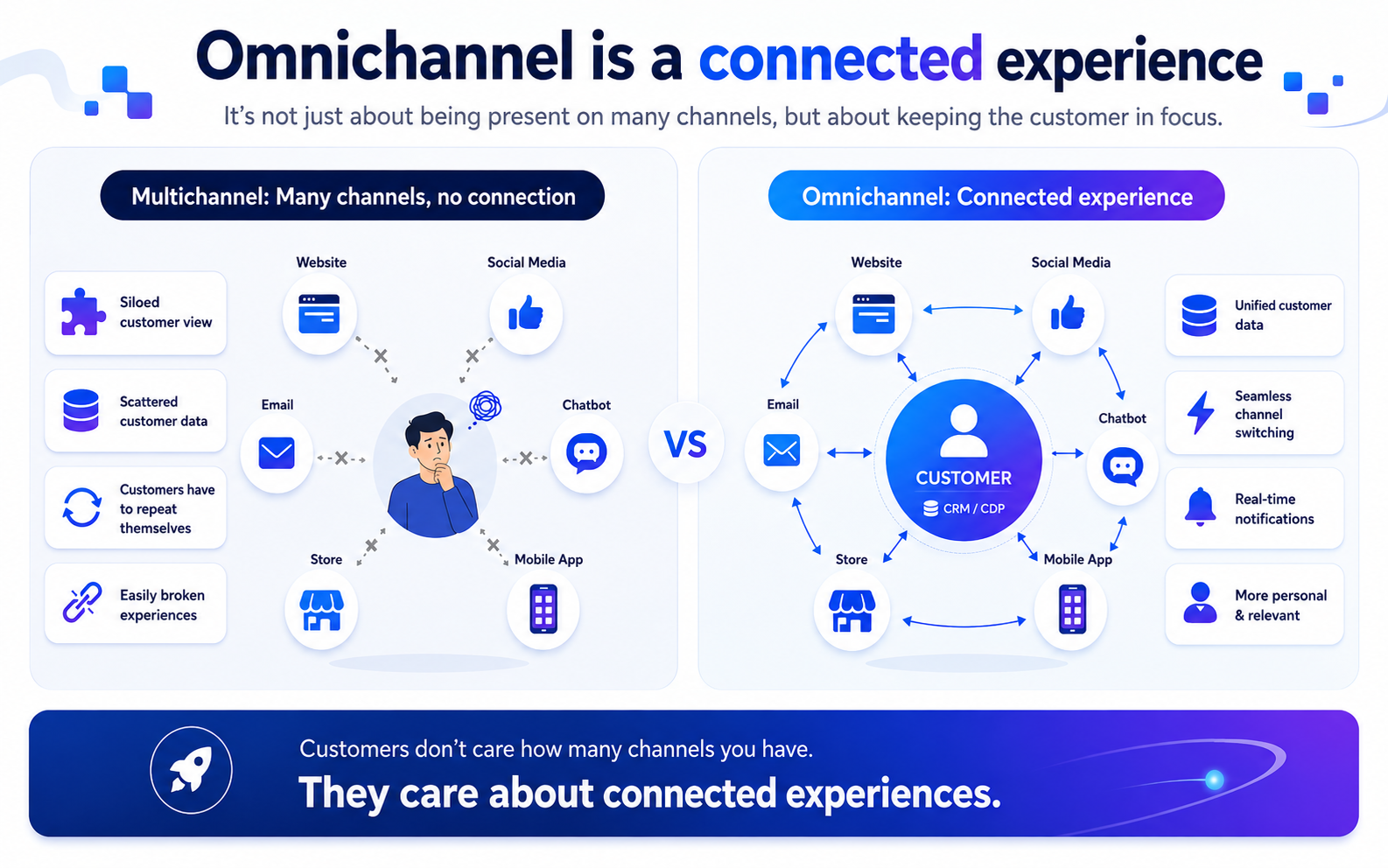
Many businesses are present on numerous channels: website, Facebook, TikTok, Zalo, email, hotline, physical stores, e-commerce marketplaces, apps, chatbots, and CRM. However, being present on many channels does not mean being omnichannel.
It is not omnichannel if:
-
A customer messages on Facebook, but the store is unaware.
-
A customer has already purchased in-store, but continues to receive new-customer notifications.
-
A customer leaves their information on the website, but the sales team is not notified.
-
A customer asks a question via chatbot, only to have to explain everything again when speaking to a human agent.
-
Promotional programs are inconsistent between online and offline.
This is merely fragmented multichannel. Omnichannel is when a customer can move between channels while the experience remains seamless, data is preserved, and the brand responds consistently.
Why is this important?
Customers do not think according to a business’s departmental structure. They do not care whether information resides in marketing, sales, retail, customer service, or the CRM system. They only care whether the brand understands them.
A customer might view a product on TikTok, ask questions via inbox, browse more on the website, visit the store, buy directly, receive post-purchase emails, and require support via a hotline. If each channel operates independently, the customer must bridge the journey themselves, making the experience exhausting. Omnichannel helps businesses maintain context throughout the journey. When context is preserved, customers are served more accurately, quickly, and consistently.
What is changing?
1. Customers move continuously between online and offline Customers may discover products online but purchase offline, or view items in-store but buy online. The boundary between online and offline is increasingly blurred. Businesses must design the journey based on how customers actually move, not how internal departments divide channels.
2. Data must travel with the customer Omnichannel cannot rely solely on synchronized content; data is the foundation. What have they viewed? What did they ask? What did they buy? Who advised them? What issues have they encountered? What is their current status? If data does not accompany the customer, the experience will break regardless of how many channels the brand is on.
3. CRM becomes the center of the experience To make omnichannel work, businesses need a central repository for customer context. When a CRM or Customer Data Platform (CDP) connects with the website, social media, inbox, stores, and customer service, the team can better understand the customer and respond appropriately.
The Digiverse Perspective
At Digiverse, we believe omnichannel should be designed through five layers:
-
Customer Journey: Businesses must know which channels customers traverse and why.
-
Channel Roles: Each channel must have a specific mission, rather than just broadcasting the same content.
-
Connected Data: Customer information must be stored and updated consistently.
-
Handoff Processes: When a customer moves from one channel to another, the team must be aware of prior context.
-
Cross-Channel Experience Measurement: Measuring the quality of the entire journey, not just individual channels.
Implementation Framework: 6 Steps to Practical Omnichannel
-
Step 1: Map the multichannel customer journey. Identify the channels customers use for awareness, consideration, inquiries, purchasing, and support. This reveals exactly where the journey breaks.
-
Step 2: Assign roles to each channel. Social media creates awareness; the website provides comprehensive info; inbox handles conversations; the store offers physical experiences; email/Zalo manages post-purchase care; and CRM maintains context. Clear roles prevent duplication and confusion.
-
Step 3: Connect customer data. Identify which data must flow across the journey: contact info, lead source, product interest, purchase history, consultation logs, feedback, and support status. Start with data that most impacts the experience and conversion.
-
Step 4: Design handoff processes. Establish clear rules for when a customer moves from social to sales, chatbot to human, online to offline, or purchase to care. Who takes over? What info is transferred? How long is the processing time?
-
Step 5: Synchronize messages and offers. Key messages, value propositions, offers, terms and conditions, and CTAs must be synchronized to an appropriate level to avoid confusion.
-
Step 6: Measure cross-channel experience. Identify where customers drop off while moving between channels (e.g., from ad to website, website to form, form to sales, purchase to support). Omnichannel is only successful if the total journey is successful.
Implications for Vietnamese Businesses
In Vietnam, customers typically use multiple channels simultaneously: Facebook, TikTok, Zalo, websites, e-marketplaces, physical stores, and hotlines. This makes omnichannel vital. However, many Vietnamese businesses still operate in silos—social isn’t connected to CRM, stores don’t know what customers viewed online, and websites have forms that sales process slowly.
Vietnamese businesses should start by connecting their most important journey: from social/ads to inbox, CRM, sales, and post-purchase care. Executing one journey well is more practical than attempting to connect everything at once.
Self-Checklist
-
Do you know which channels your customers traverse?
-
Does each channel have a clear role in the journey?
-
Does customer data travel with the customer between channels?
-
Is there a handoff process between social, sales, retail, and service?
-
Are messages and offers consistent?
-
Do customers have to explain their information multiple times?
-
Are you measuring drop-offs between channels?
If many answers are “Unclear,” you may have many channels, but lack an omnichannel experience.