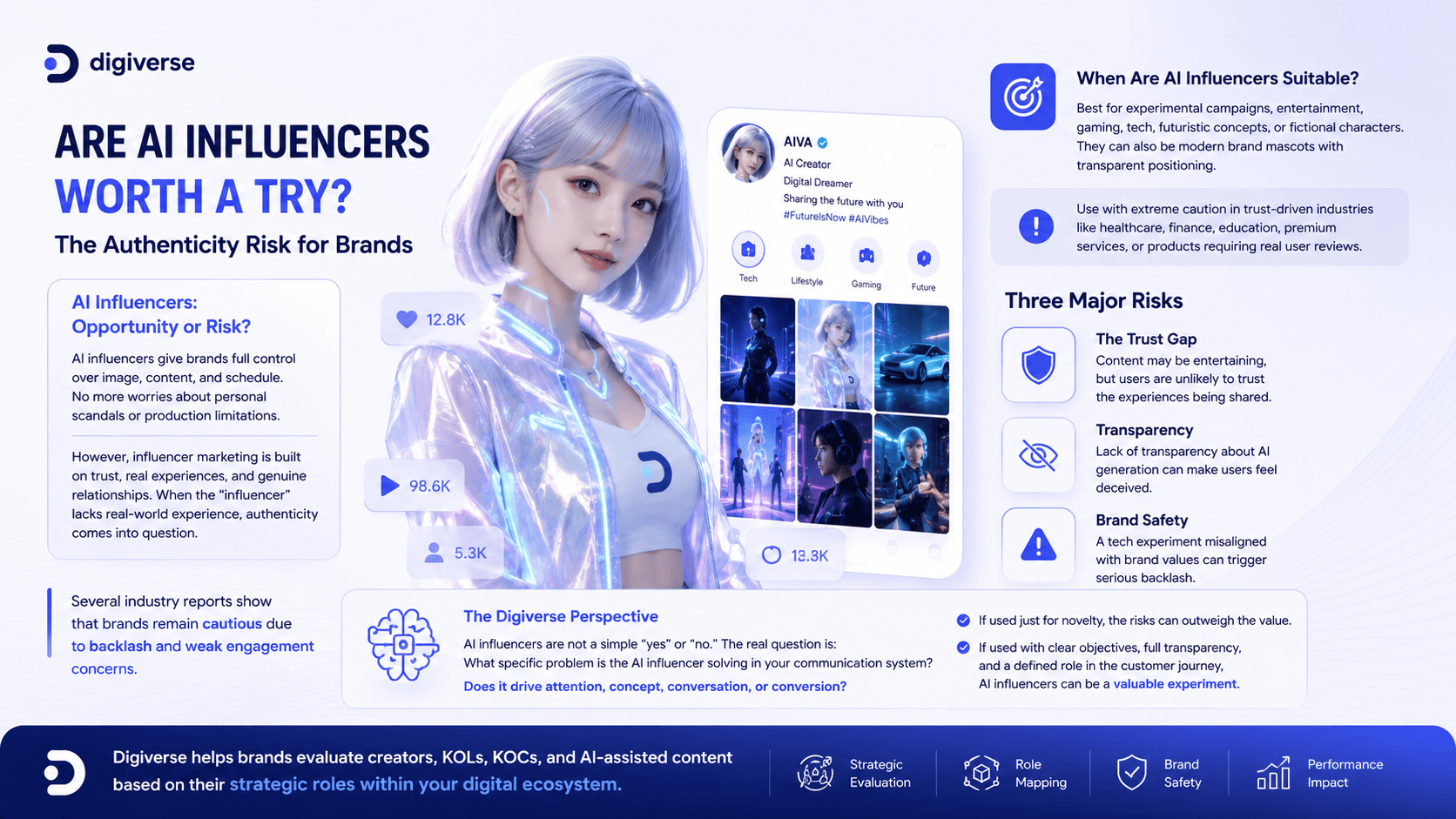
AI Influencers: Opportunity or Risk?
AI influencers are attracting attention because brands can control their image, content, and schedule. Brands no longer need to worry about personal schedules, private life scandals, or the production limitations of real humans.
However, influencer marketing has historically been rooted in the trust, experiences, and relationships between influencers and their communities. When the “influencer” lacks genuine real-world experience, questions about authenticity arise immediately. Several industry reports have noted brand caution regarding AI influencers due to fears of backlash and lower-than-expected engagement.
When Are AI Influencers Suitable?
AI influencers may be suitable for experimental campaigns, highly entertaining categories, futuristic concepts, gaming, tech, or content featuring fictional characters. They can also serve as modern brand mascots if they are positioned transparently.
However, for industries that rely heavily on trust—such as healthcare, finance, education, premium services, or products that require genuine user reviews—brands should exercise extreme caution.
Three Major Risks
- The Trust Gap: Users may find the content interesting, but they are unlikely to trust the experiences being shared.
- Transparency: If a brand is not transparent about the character being AI-generated, users may feel deceived.
- Brand Safety: A technological experiment that does not align with the brand’s core values can trigger a significant backlash.
The Digiverse Perspective
At Digiverse, we do not view AI influencers as a binary “yes” or “no.” The right question is: What specific problem is the AI influencer solving within your communication system? Does it generate attention, concept, conversation, or conversion?
If used simply for novelty, the risks may outweigh the value. If used with clear objectives, full transparency, and a defined role in the customer journey, AI influencers can be a worthwhile experiment.