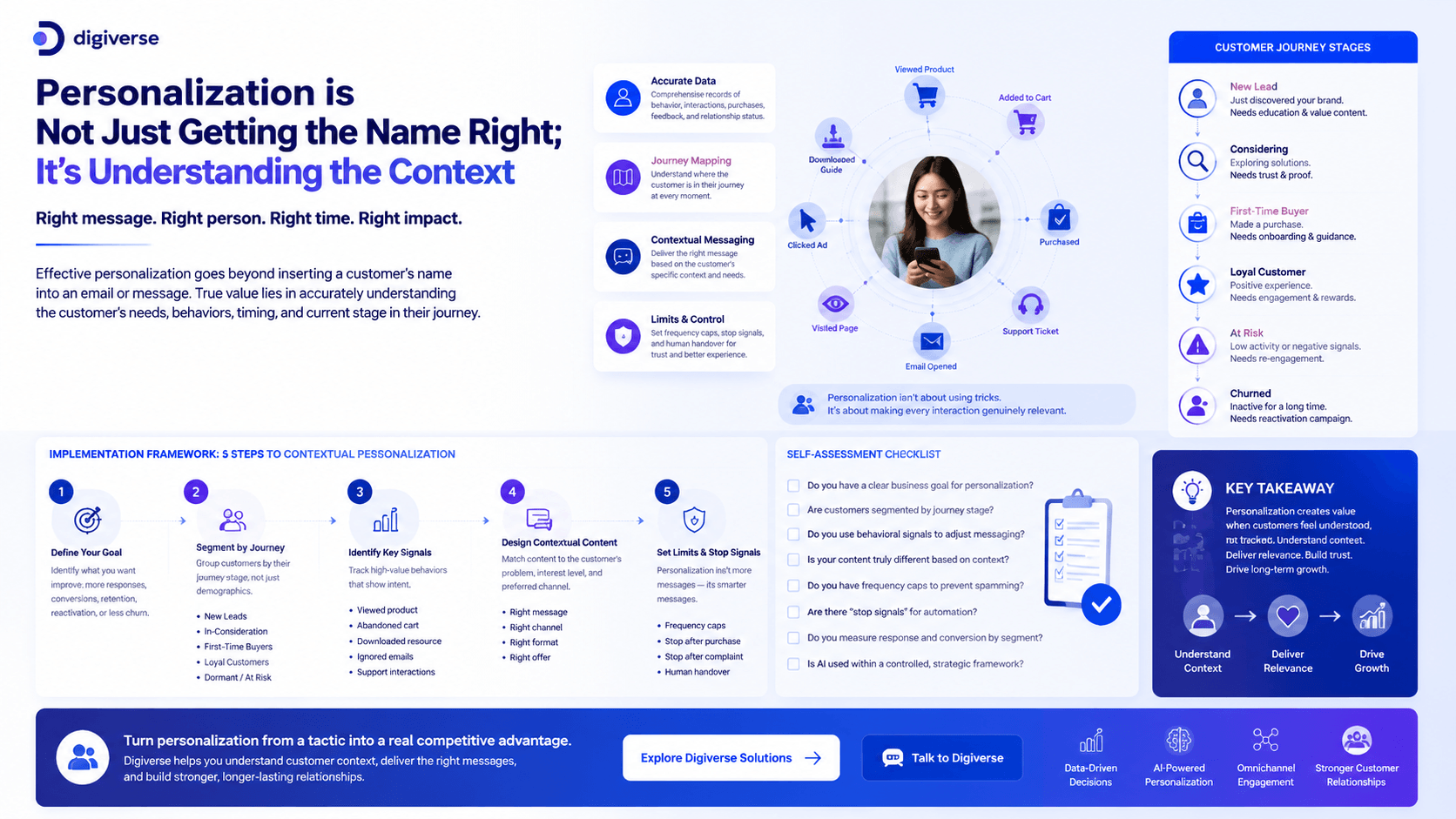
Good Personalization Makes Customers Feel Understood Personalization helps brands deliver messages that align with a customer’s specific needs, behaviors, and stage in the journey. When executed well, customers feel that the brand truly “gets” them, which saves them time and effort.
However, over-personalization or a lack of subtlety can create a sense of being stalked or monitored. This is a critical boundary in customer experience (CX).
Relevance vs. Creepiness There is a fine line between being relevant and being “creepy.”
- Relevance occurs when a brand uses data to improve the experience—for example, reminding a customer about a product they’ve shown interest in, suggesting content that matches their intent, or providing assistance at the right stage of their journey.
- Creepiness occurs when the messaging is overly private, too direct, or leaves the customer wondering, “How on earth do they know that?” This feeling typically arises when businesses use data out of context or without clear, transparent permission.
Start with Low-Sensitivity Data Businesses can begin their personalization journey using simple, non-intrusive signals: categories of interest, interaction behavior, purchase history, lifecycle stage, activity level, or preferred channels.
You don’t need to dive into deep, sensitive profiling from day one. A message that is relevant to the customer’s needs, delivered at the right time, and written in the right tone is significantly more effective than a message that signals, “We know everything about you.”
The Digiverse Perspective
At Digiverse, we believe personalization should be designed based on four core principles: Helpful, Contextual, Controlled, and Measurable. Personalization is not about a brand showing off how much data it has; it is about providing the customer with a better, more meaningful experience.
Self-Audit Questions
- Do customers understand why they are receiving this message?
- Is the content genuinely useful to the recipient?
- Is the data used for personalization appropriate and secured?
- Does the frequency of communication cross the line into being a nuisance?
Call to Action Digiverse helps businesses design personalization logic that balances customer value, data privacy, and business growth.
[Explore Digiverse Solutions] | [Talk to Digiverse]
I am ready for the next topic whenever you are!
18
What Does AI Personalization Need to Be Effective?
SEO Title: What Does AI Personalization Need to Be Effective? SEO Description: AI personalization is only effective when a business has clean data, clear segmentation, accurate customer journeys, and robust engagement rules. Slug: ai-personalization-requires-good-data Category: Customer Experience, CRM & Loyalty
AI Personalization: A Massive Opportunity That Cannot Replace a Strong Data Foundation
AI Does Not Automatically Create Good Personalization AI can assist marketers in generating content variants, predicting needs, suggesting next-best actions, and personalizing experiences at scale. However, AI is only effective when built upon a strong data foundation.
If your data is flawed, your segmentation is vague, or your customer journey is poorly defined, AI will simply scale your inefficiencies and confusion faster.
Three Prerequisites for AI Personalization
- Data Structure: Businesses must understand which customer data fields they possess, which sources are reliable, which data is updated frequently, and what data should not be used.
- Segmentation: Not all customers are the same. Businesses need to group customers based on value, behavior, needs, or lifecycle stage.
- Engagement Rules: AI needs guardrails. It must know when to send a message, what to send, through which channel, at what frequency, and—crucially—when to stop.
AI Should Empower Marketer Decision-Making AI personalization is not just about automatically creating more content. Its greater value lies in its ability to help teams identify patterns: which customer segments are likely to return, which content is suitable for each stage, which customers need incentives, and which require active consultation.
Many international enterprises emphasize that AI brings marketers closer to the “segment of one,” but this remains heavily dependent on the quality of customer data and the ability to bridge that data with actionable marketing.
The Digiverse Perspective
At Digiverse, we view AI personalization as the optimization layer on top of a CRM/CX stack, not the starting point. Businesses should first build their customer data logic, lifecycle journeys, and content systems. Once the foundation is solid, AI can help scale personalization while ensuring that the overall customer experience remains controlled and relevant.