Chatbots Are Not the Entirety of CX AI chatbots can help businesses answer frequently asked questions, guide users through processes, categorize inquiries, support self-service, and reduce the workload for customer support teams. However, chatbots should not be viewed as the solution for every CX scenario.
Customers don’t just need quick answers. They need to be accurately understood, correctly handled, and—in many cases—they need to feel that their frustrations are being empathized with.
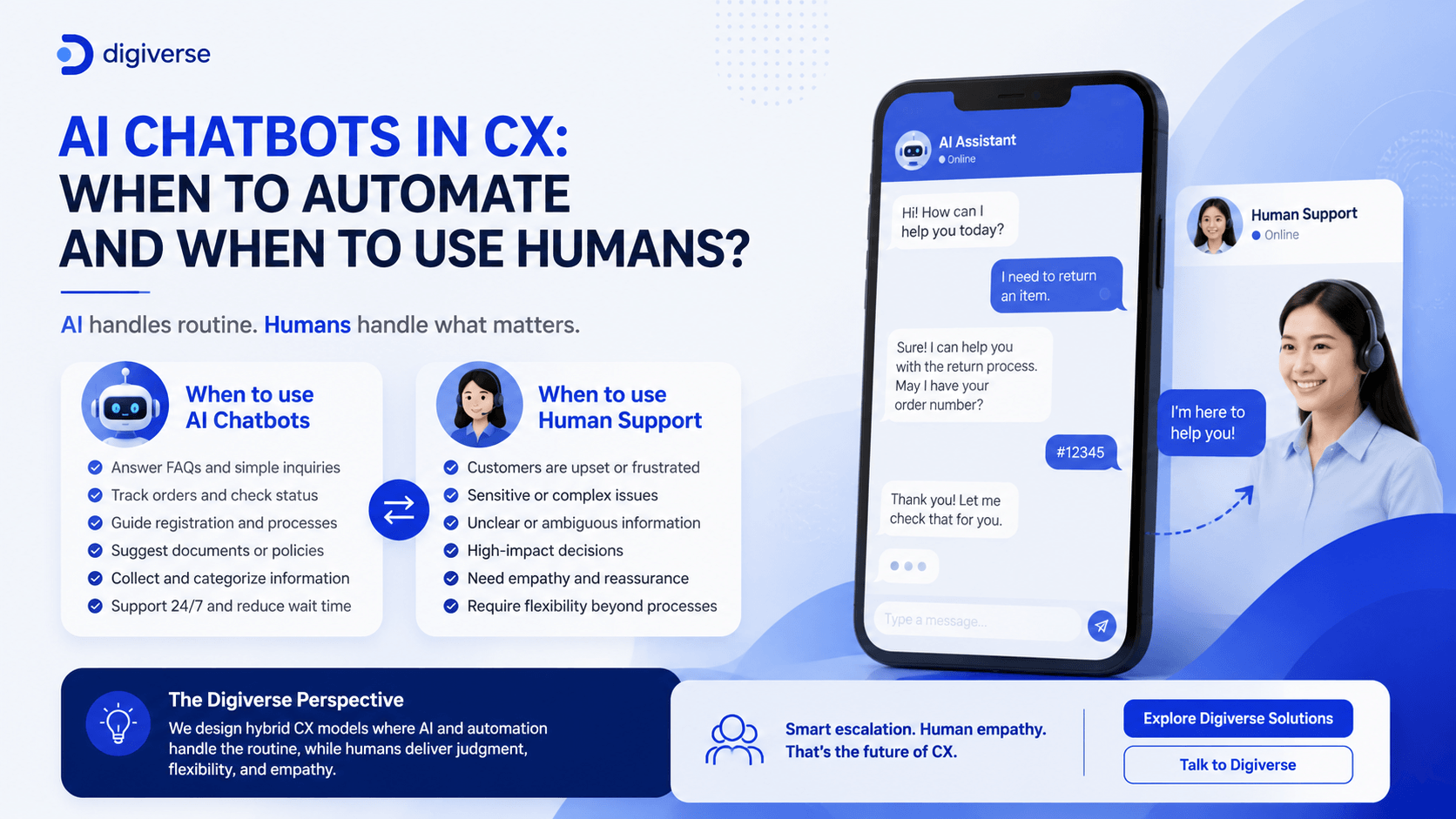
When Should You Use AI Chatbots? AI chatbots are ideal for repetitive situations, clear-cut processes, and tasks with low emotional risk: inquiring about opening hours, tracking orders, guiding through registration, checking policies, suggesting documentation, categorizing needs, or gathering preliminary information.
In these cases, AI helps provide faster responses while allowing human team members to focus their energy on more complex, high-value issues.
When Is a Human Required? Human intervention is essential when a customer is upset, when the issue is sensitive, when information is ambiguous, when a decision has significant consequences, or when flexibility outside of standard procedures is required. If a chatbot attempts to handle everything, the experience can quickly become cold, robotic, and frustrating.
Recent industry discussions on AI in CX emphasize the importance of “human-centered design”—the idea that AI should support, not entirely replace, the human experience.
The Digiverse Perspective
At Digiverse, we propose a hybrid CX model: AI handles routine tasks, automation supports internal workflows, and humans handle situations requiring judgment and empathy. The most critical element is designing a clear “escalation logic” so that customers never feel trapped in a chatbot loop.