Opening Statement
A post with many likes is a good signal. A video with high views is a good signal. A review with many comments is also a good signal. However, if the customer does not know what to do next after that engagement, the content stops at mere visibility.
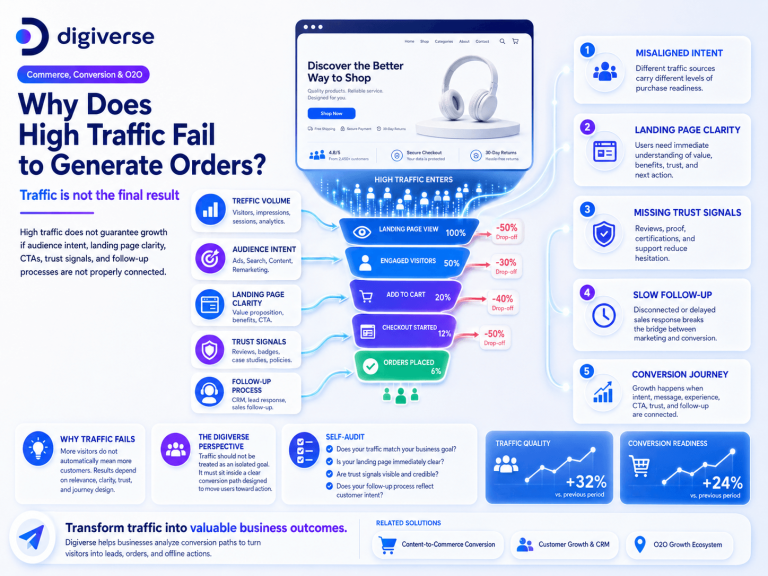
Content can generate attention but fail to drive consideration. It can evoke emotion but leave the product unclear. It can pull traffic, but if the landing page is not clear enough, it will fail to convert. Content-to-commerce is the method of connecting content to commercial actions. These actions do not always have to be immediate purchases; they can be messaging, signing up, booking an appointment, downloading documents, adding to a cart, saving products, visiting a store, or leaving contact information for consultation. The key is that the content must know where it is leading the customer.
Why is this important?
In the digital environment, customers often travel from content to action through several steps: seeing a video, reading more information, checking reviews, comparing options, visiting a landing page, messaging for inquiries, adding to a cart, receiving follow-up care, and finally making a decision. If content is not connected to commercial touchpoints, customers easily fall out of the journey.
A great video without a clear link or CTA misses an opportunity. An informative article without a path to a product page or consultation form struggles to drive conversion. A review that builds trust without a tracking mechanism makes it difficult to measure real effectiveness. Content-to-commerce helps businesses turn content into part of a conversion system, rather than just a communications activity.
What is changing?
1. Customers expect shorter and clearer journeys When customers are interested, they do not want to take many steps to find the next piece of information. They want to know where the product is, what the value is, what proof exists, and how to buy or contact the business. Content needs to bridge the gap between inspiration and action. This does not mean every piece of content must sell directly, but every piece of content must provide a next step appropriate for the customer’s readiness level.
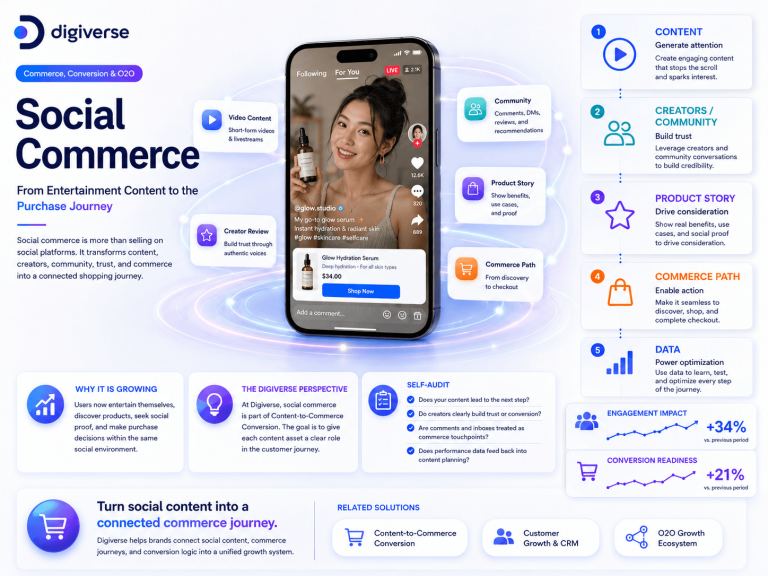
2. Social, video, and creators are getting closer to commerce Social commerce, livestream commerce, creator affiliates, shoppable content, and concise landing pages are narrowing the gap between content and sales. Customers can discover products via video, inquire via inbox, buy via a link, save coupons, or read evaluations right on the platform. This makes content-to-commerce a critical competency, especially for retail, services, education, beauty, F&B, and e-commerce.
3. Measuring content must go beyond engagement If you only measure likes, views, or comments, it is difficult to determine if content contributes to business results. Content-to-commerce requires tracking clicks, inbox queries, form submissions, add-to-carts, coupon usage, calls, bookings, leads, conversion rates, and order values. With deeper measurement, teams will know which content generates attention and which content actually drives customers forward.
The Digiverse Perspective
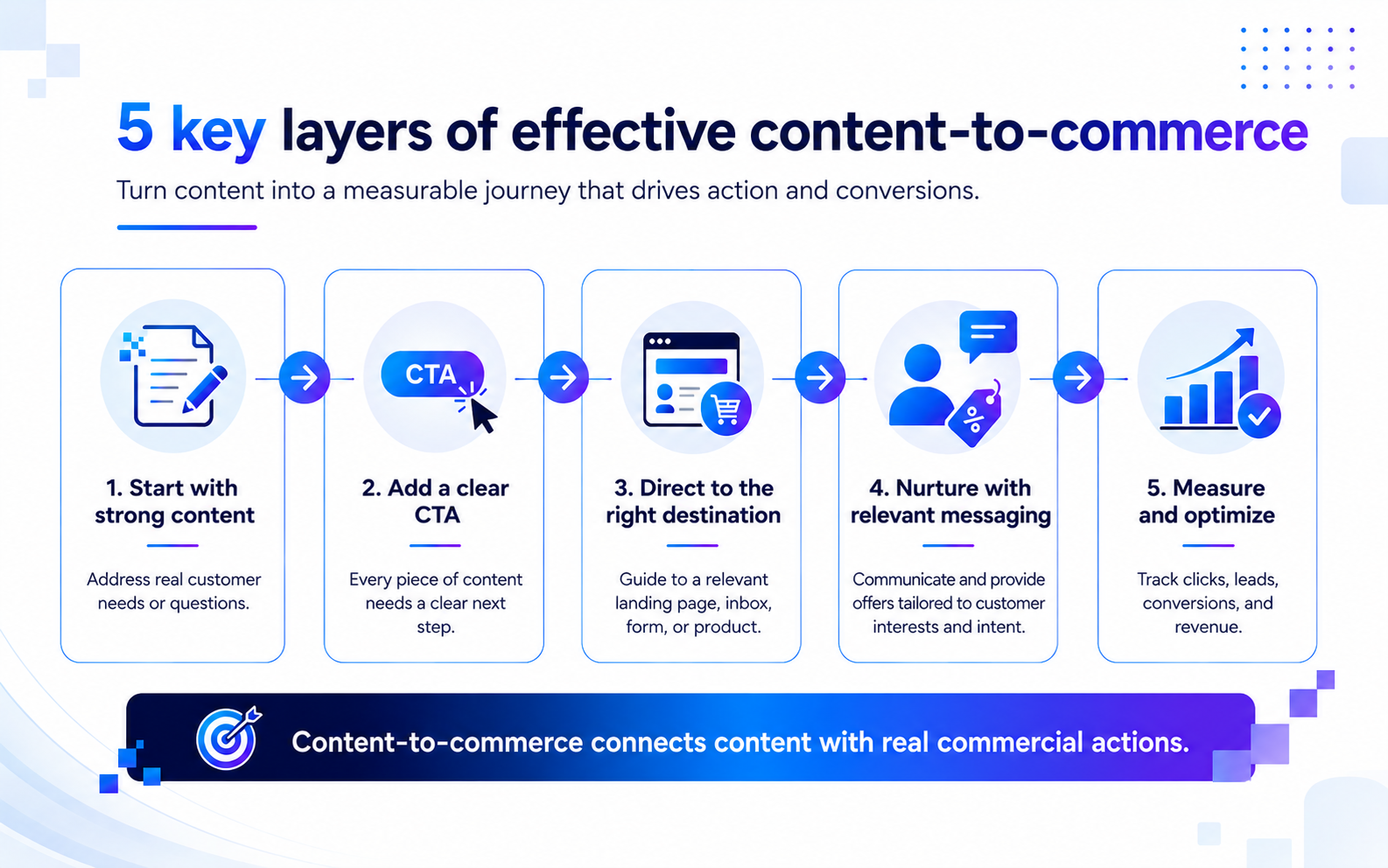
At Digiverse, we believe content-to-commerce requires five layers of connection:
-
Content that generates attention: Short videos, social posts, creator reviews, or articles that frame a problem.
-
Product stories that build consideration: Customers need to understand what problem the product solves, how it differs, and who it is for.
-
Commercial touchpoints that create clarity: Landing pages, product pages, inbox, forms, chatbots, or physical stores that provide full information and clear CTAs.
-
Conversion flows that generate action: Purchasing, registering, booking, messaging, downloading, or visiting a store.
-
Feedback data for optimization: Businesses need to know which content triggers actions and where customers drop off.
Implementation Framework: 6 Steps to Building Content-to-Commerce
-
Step 1: Define the desired action. Before creating content, know the goal: purchase, message, book, consult, download, add to cart, or visit a store? Different actions require different CTAs and touchpoints.
-
Step 2: Design content based on customer readiness. New customers need problem-framing content. Considering customers need proof and detailed information. Customers near conversion need clear reasons to act and explicit CTAs.
-
Step 3: Connect content to commercial touchpoints. Each piece of content needs a path forward. Social posts can link to landing pages; videos can link to inbox or product links; reviews can attach tracking codes; blogs can link to consultation forms.
-
Step 4: Clarify information at the point of conversion. Landing pages, product pages, or inbox sessions must answer key questions: What is the product? Who is it for? What is the benefit? What is the proof? What is the price/consultation process? And what is the next step?
-
Step 5: Connect data to measure effectiveness. Use UTMs, unique promo codes, tracking links, specific forms, or CRM data to attribute actions to specific content.
-
Step 6: Optimize based on drop-offs. If content has many views but few clicks, the CTA may be unclear. If clicks are high but form submissions are low, the landing page may not be persuasive. If forms are high but sales are low, the consultation or follow-up process needs improvement.
Implications for Vietnamese Businesses
In Vietnam, customers discover products via Facebook, TikTok, livestreams, reviews, groups, e-marketplaces, and inbox. Content-to-commerce has immense potential here. However, many businesses still split content and sales into two separate silos. Social teams create content without knowing what drives inbox volume; media teams pull traffic to unclear landing pages; creator reviews lack tracking; sales teams receive leads without knowing the content origin; and CRM data isn’t fed back to the content team. Vietnamese businesses can start by focusing on one key product/service, designing a clear journey from content to action, applying basic tracking, and optimizing drop-off points.
Self-Checklist
-
Does each piece of content have a clear intended action?
-
Do you differentiate content for awareness, consideration, and conversion?
-
Does your content have a clear and appropriate CTA?
-
Do your landing pages, inboxes, or product pages provide sufficient conversion information?
-
Is there tracking to identify which content generates action?
-
Are you measuring drop-offs between views, clicks, forms, inbox, and purchases?
-
Do you use conversion data to improve your content?
If many answers are “Unclear,” your content may be generating engagement but remains disconnected from commerce.