Opening Statement
Customer journey mapping is a familiar tool in marketing, customer experience (CX), and digital transformation. Businesses map out the stages customers go through: awareness, consideration, purchase, usage, post-purchase care, and retention.
These diagrams can be beautiful, filled with colors, icons, touchpoints, emotions, pain points, and opportunities for improvement. However, a journey map only holds value when it leads to operational change.
-
If the map is completed and left in a slide deck, it creates no value.
-
If pain points are recorded but never addressed, the journey does not improve.
-
If touchpoints are listed but data remains siloed, the experience remains fragmented.
-
If customer drop-offs are not measured, the business continues to optimize based on intuition.
-
If teams do not change how they collaborate, the map remains merely a reference document.
Customer journey mapping is not an exercise in drawing diagrams. It is a way for businesses to reflect on the customer experience to fundamentally change how they operate.
Why is this important?
Customers do not experience a business department by department; they experience a seamless journey. They see ads, read content, visit the website, chat, consult with sales, buy products, receive them, seek support, and decide whether to return.
However, within the business, this journey is often broken down into silos:
-
Marketing manages awareness.
-
Sales manages consultation.
-
E-commerce manages orders.
-
Customer Service manages support.
-
CRM manages re-engagement.
-
Operations manage delivery or implementation.
If these teams do not look at the same journey, customers will encounter fragmented experiences. Customer journey mapping helps businesses look through the eyes of the customer, rather than just through internal structures.
What is changing?
1. The customer journey is becoming increasingly complex Customers may start on social media, switch to search engines, read reviews, ask friends, visit the website, chat, visit a physical store, buy online, and require post-purchase support. The journey is no longer linear. This forces businesses to understand which touchpoints are critical, where drop-offs occur, and where data needs to be connected.
2. Journey maps must incorporate real data A map based solely on internal assumptions is prone to inaccuracies. Businesses must utilize data from websites, social media, CRM, sales, customer service, surveys, interviews, and actual feedback. Data ensures the map reflects real behavior, not just what the business thinks the customer is doing.
3. Journey maps need periodic updates Customer behavior shifts with channels, technology, market trends, and experience expectations. Therefore, a customer journey map should not be a “one-and-done” document. Businesses need to update their maps when launching new products, new channels, new campaigns, or when significant drop-off points are discovered.
The Digiverse Perspective
At Digiverse, we believe customer journey mapping should be utilized as an operational tool. An effective journey map consists of six layers:
-
Journey Stages: From awareness to consideration, action, experience, and retention.
-
Touchpoints: Where customers meet the brand (social, website, email, inbox, store, hotline, CRM).
-
Customer Needs & Questions: What the customer needs to know at each stage to move forward.
-
Pain Points & Breakpoints: Where customers feel confused, slowed down, uninformed, or lose trust.
-
Data & Signals to Track: Metrics needed to assess if the journey is performing well.
-
Improvement Actions & Owners: Who is responsible for each improvement and the deadline for resolution.
Implementation Framework: 6 Steps to Value-Driven Customer Journey Mapping
-
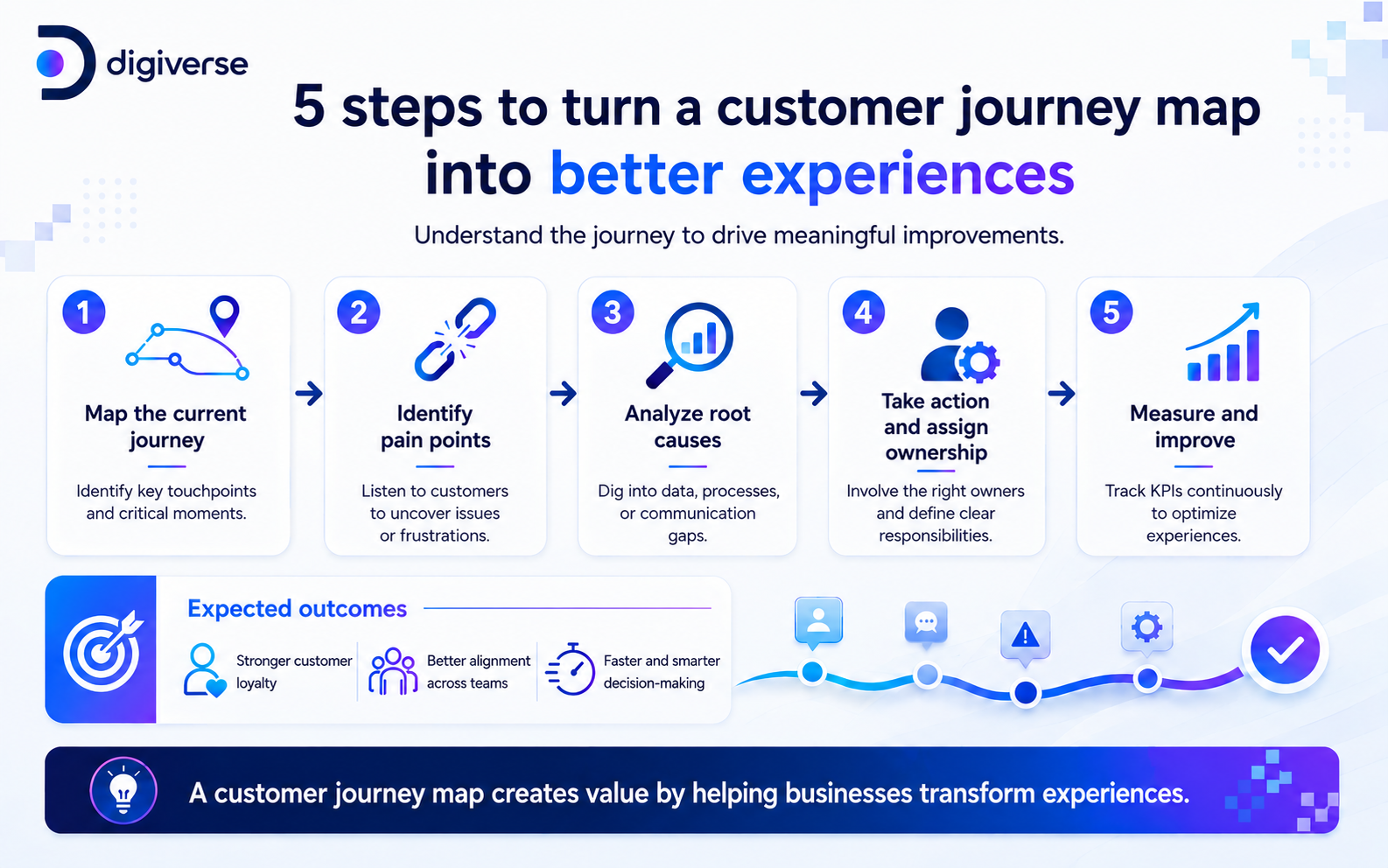
Step 1: Select a specific journey. Do not start with the entire enterprise. Choose specific journeys like new customers, customers leaving information, first-time buyers, or those needing support. The more specific the journey, the easier it is to convert into action.
-
Step 2: Collect data from multiple sources. Combine quantitative and qualitative data (website metrics, CRM, ads, social comments, inbox, sales feedback, customer service feedback, and surveys).
-
Step 3: Map stages and touchpoints. Identify customer stages and brand interactions. At each point, define customer needs, what the business provides, and potential blockers.
-
Step 4: Identify breakpoints. Breakpoints include unclear information, slow responses, vague CTAs, lack of data transfer, redundant data entry, or inconsistent channel experiences. This is the most crucial part of mapping.
-
Step 5: Prioritize improvement actions. Prioritize based on impact and feasibility (e.g., what drives conversion most? What loses trust? What can be fixed quickly?).
-
Step 6: Assign owners and measure results. Every action needs a lead, a deadline, and a KPI. Without owners, the map stops at analysis. Without metrics, improvement effectiveness cannot be verified.
Implications for Vietnamese Businesses
In Vietnam, customers traverse many touchpoints: Facebook, TikTok, Zalo, websites, e-commerce platforms, retail stores, hotlines, and inbox. This leads to frequent journey fragmentation:
-
Queries on Facebook aren’t saved to CRM.
-
Online product views are unknown to physical stores.
-
Form submissions receive slow sales follow-ups.
-
Post-purchase care is non-existent.
-
Customers receive promotional texts despite having lodged complaints.
Vietnamese businesses should start with simple but actionable journey maps. Focus on identifying and fixing breakpoints.
Self-Checklist
-
Do you have a journey map for key customer segments?
-
Is the map based on real data?
-
Are both online and offline touchpoints listed?
-
Are pain points and breakpoints identified?
-
Are improvement actions prioritized?
-
Does every action have a clear owner?
-
Are there metrics to measure improvements?
-
Is the map periodically updated?
If many answers are “Unclear,” the customer journey map is likely just a presentation document, not an operational tool.