Opening Statement
In almost every business, there exists a group of customers who were once interested, who bought something, or who interacted, but have since gone silent.
-
They don’t open emails.
-
They don’t respond to messages.
-
They don’t return to purchase.
-
They don’t engage with content.
-
They don’t visit the website.
-
They don’t respond to offers.
-
They have fallen out of the customer care journey.
Many businesses handle this group by simply sending offers: discounts, vouchers, reminder messages, promotional emails, time-limited notifications, or “come back” incentives.
While offers can be effective in some cases, they are not a “one-size-fits-all” solution. Customers may stay silent for many reasons: they no longer have a need, their previous experience was poor, they don’t understand the product value, they are suffering from message fatigue, they have switched to a competitor, or they simply haven’t been given a compelling reason to return.
Reactivation should not start with the question, “What offer should we send?” It should begin with, “Why are they silent?”
Why is this important?
Existing or formerly engaged customers often have higher potential value than entirely new groups. They already know the brand, have left data, and possess a history of interaction or purchase.
However, if reactivation is done poorly, businesses risk further alienating customers:
-
Sending too many messages can lead to channel blocking.
-
Sending irrelevant offers can diminish brand image.
-
Sending overly aggressive messages can create resentment.
-
Sending identical content to all inactive customers is a waste of data.
Effective reactivation requires understanding the context of the silence and creating a relevant invitation to return.
What is changing?
1. Inactive customers are not a monolithic group Do not lump all inactive customers into one bucket. Some were one-time buyers who haven’t returned in a while; others left information but never purchased; some were frequent interactors who stopped; others were complainers or seasonal buyers. Each group requires a different activation approach.
2. Behavioral data reveals the “Why” Businesses can use data to read signals. Did they stop after viewing the price? After receiving a consultation? After their first purchase? After a complaint? After multiple unopened emails? Or perhaps after their product’s usage cycle ended? Each “drop-off point” suggests a different hypothesis.
3. Reactivation needs frequency capping Re-engaging doesn’t mean sending messages continuously until they respond. Businesses must set limits: how many times to send, over what period, via which channels, and when to stop. Respecting customer silence is also a part of the customer experience.
The Digiverse Perspective
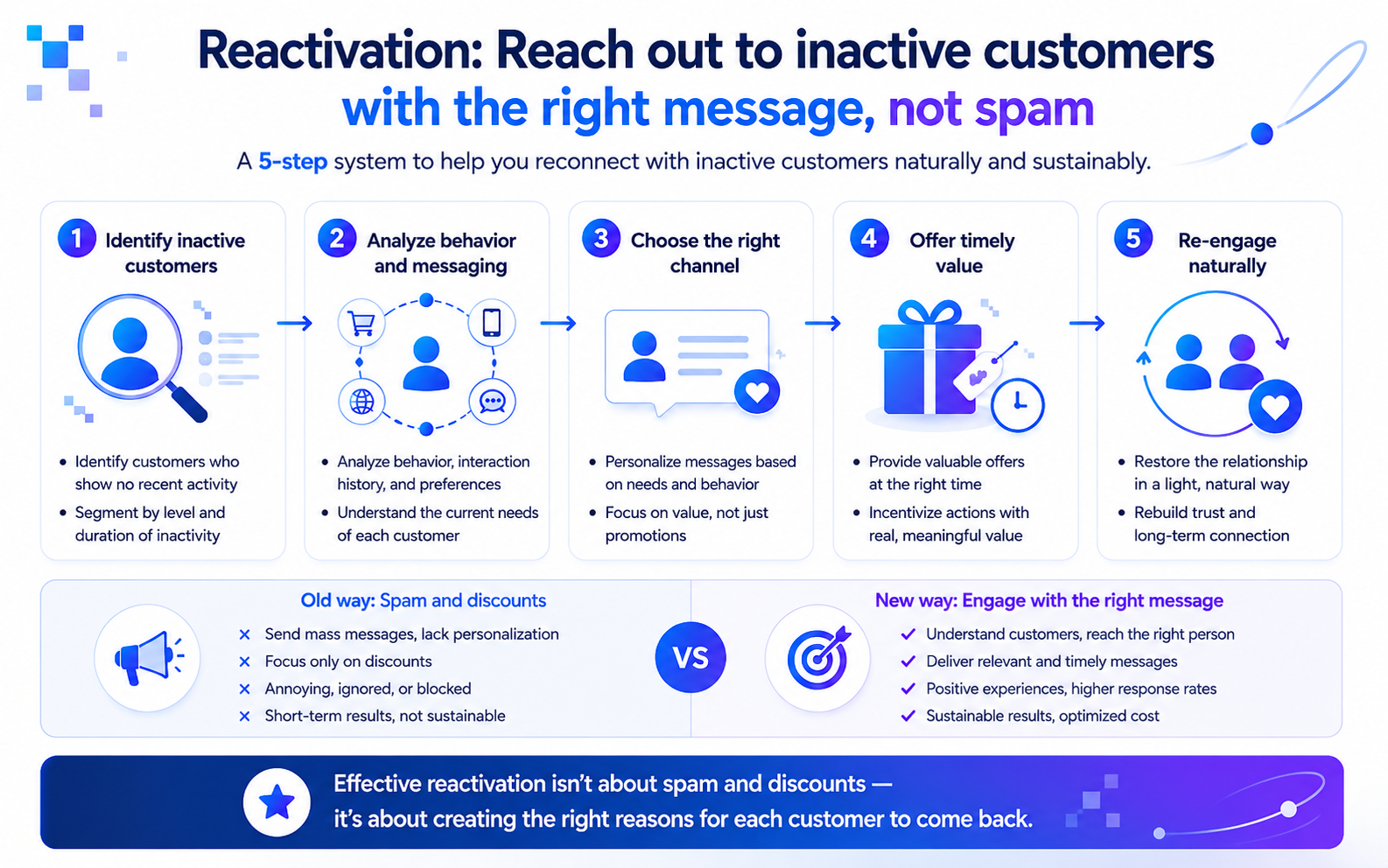
At Digiverse, we believe reactivation should be designed as a contextual journey. An effective reactivation system consists of five layers:
-
Segmentation of inactive customers: Do not treat all silent customers as the same.
-
Hypothesis on the reason for silence: Based on behavioral data, purchase history, and feedback.
-
Relevant re-engagement messages: Some groups need offers, while others need educational content, support, or a request for feedback.
-
Appropriate activation channels: Select the right channel (Email, Zalo, SMS, social retargeting, inbox, or direct calls) based on the context.
-
Stop signals: When a customer does not respond, stop the outreach to avoid being intrusive.
Implementation Framework: 6 Steps to Proper Reactivation
-
Step 1: Define what “inactive” means. Businesses must define silence based on their industry and purchase cycle (e.g., 30, 60, or 90 days). Without a clear definition, you cannot activate at the right time.
-
Step 2: Segment inactive customers. Group by behavior: one-time buyers, frequent buyers who stopped, leads who never purchased, cart abandoners, negative feedback givers, or those who haven’t opened messages in a long time.
-
Step 3: Hypothesize the reason for silence. Is it a lack of perceived value? Price? Trust? Poor experience? No current need? Or a shift to a competitor? Hypotheses make messages more accurate.
-
Step 4: Design re-engagement messages. It doesn’t always have to start with a discount. Try educational content, new product announcements, periodic reminders, check-ins, short surveys, personalized offers, or invitations for consultation.
-
Step 5: Set frequency caps and stop signals. If a customer doesn’t open messages multiple times, reduce frequency. If feedback is negative, redirect the handling. If they have repurchased, stop the reactivation flow and move them to post-purchase care.
-
Step 6: Measure performance by segment. Track which segments respond best, which messages are effective, and which channels work. Reactivation should be an iterative process learned from data.
Implications for Vietnamese Businesses
In Vietnam, businesses possess valuable data across CRM, Zalo OA, Email, E-commerce platforms, Fanpages, and websites. However, many campaigns still rely on mass-distributed offers.
Vietnamese businesses should start by segmenting into three simple groups: first-time buyers who haven’t returned, leads who haven’t purchased, and long-term inactive customers. For each, design tailored messages instead of sending the same discount code to everyone.
Self-Checklist
-
Do you have a clear definition of an “inactive customer”?
-
Are inactive customers segmented?
-
Is there a hypothesis for the reason behind the silence for each segment?
-
Do re-engagement messages vary by context?
-
Are there frequency caps?
-
Are there stop signals for non-responsive customers?
-
Do customers who repurchase transition to a post-purchase care journey?
-
Is reactivation effectiveness measured by segment?
If many answers are “Unclear,” you may be spamming offers instead of contextually reactivating your customers.