AI Does Not Automatically Create Good Personalization
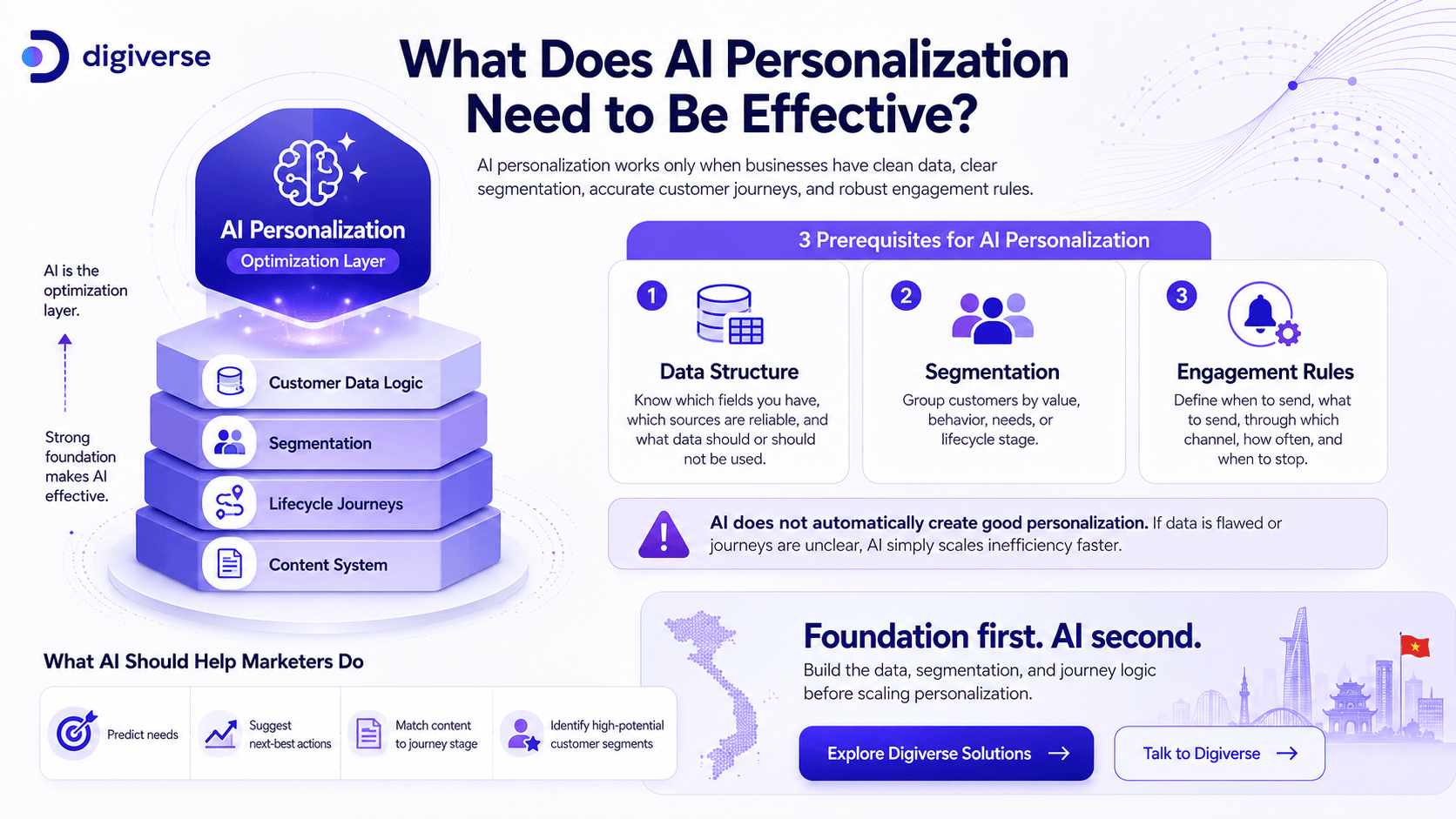
AI can help marketers generate multiple content variations, predict needs, suggest the “next-best action,” and personalize experiences at scale. However, AI is only effective when built upon a solid data foundation.
If the data is inaccurate, the segmentation is vague, or the customer journey is ill-defined, AI will simply scale the confusion faster.
Three Foundations Required Before AI Personalization
- Data Structure: Businesses must understand which fields their customer data contains, which sources are reliable, which data is updated frequently, and which data should be avoided.
- Segmentation: Not all customers are the same. Businesses need to group customers based on value, behavior, needs, or lifecycle stages.
- Engagement Rules: AI needs to know when to send communication, what to send, through which channels, at what frequency, and when to stop.
AI Should Support Marketer Decision-Making
AI personalization is not just about automatically writing more content. Its greater value lies in helping teams identify patterns: which customer segments are likely to return, which content is suitable for each stage, which customers need incentives, and which customers need consultation.
Several international enterprises have emphasized that AI helps marketers get closer to the “segment of one,” but this still heavily depends on customer data and the ability to connect that data with actionable outcomes.
The Digiverse Perspective
Digiverse views AI personalization as an optimization layer on top of a CRM/CX foundation, not as a starting point. Businesses should build their customer data logic, lifecycle journey, and content system first. Once the foundation is strong enough, AI can help scale personalization while maintaining control over the customer experience.