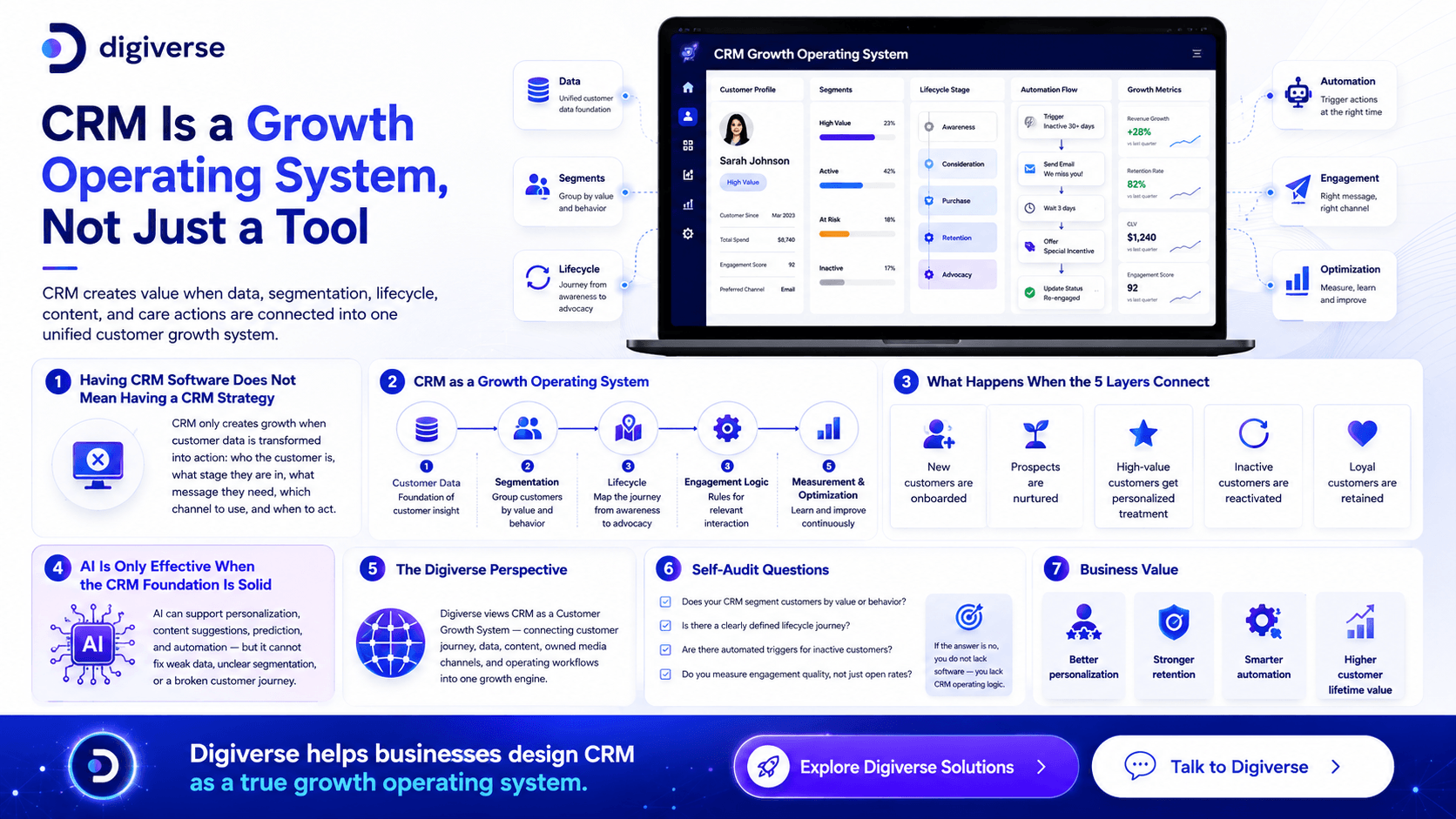
Having CRM Software Does Not Mean Having a CRM Strategy
Many businesses invest in CRM software with the expectation of managing customers more effectively. However, if the CRM serves merely as a repository for names, phone numbers, emails, and purchase history, it will not generate growth.
A CRM only creates value when data is transformed into action: knowing what stage a customer is in, which value segment they belong to, what message they should receive, through which channel, and at what specific moment.
CRM as a Growth Operating System
A high-performing CRM operating system is built on five layers:
- Customer Data: The foundation of all insights.
- Segmentation: Categorizing customers based on traits and behavior.
- Lifecycle: Mapping the customer’s journey from awareness to advocacy.
- Engagement Logic: The rules for how to interact with customers.
- Measurement and Optimization: Continuously refining the process.
When these five layers are connected, businesses stop sending the same generic message to everyone. Instead, new customers are onboarded, prospects are nurtured, high-value customers receive personalized treatment, inactive customers are reactivated, and loyal customers are maintained.
AI Is Only Effective When the CRM Foundation Is Solid
AI can assist with personalization, content suggestions, behavioral prediction, and interaction automation. However, AI cannot fix a CRM system that lacks clean data, clear segmentation, or a well-defined journey. Successful cases of AI-driven personalization consistently highlight the essential role of robust customer data and the ability to bridge that data with marketing actions.
The Digiverse Perspective
At Digiverse, we view CRM as a Customer Growth System. It is not a “tool implementation project”; it is a strategic challenge of connecting the customer journey, data, content, owned media channels, and operating workflows.
Businesses should approach CRM by answering these fundamental questions: Which customers are most important? Which specific value metrics need to grow? What behaviors need to be triggered? And which parts of the journey should be automated first?
Self-Audit Questions
- Does your current CRM segment customers based on value or behavior?
- Is there a clearly defined lifecycle journey in place?
- Are there automated triggers for inactive customers?
- Do you measure engagement quality rather than just open rates?
If the answer is “no,” your business doesn’t lack software—it lacks a CRM operating logic.