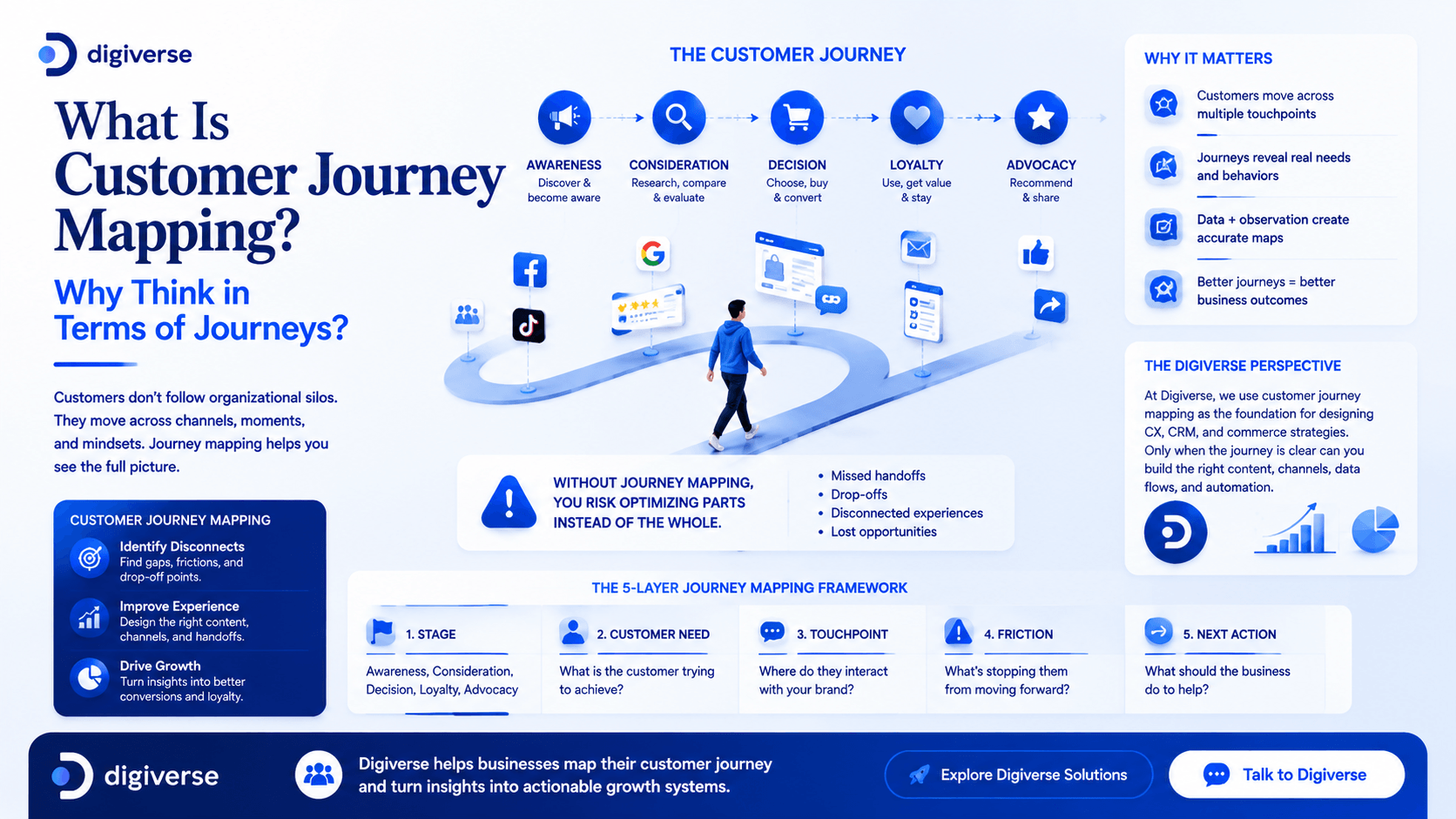
Customers Don’t Follow Organizational Silos Businesses often organize their digital operations by channels: social, website, ads, CRM, e-commerce, and sales. However, customers do not experience a brand that way. They might see an ad on Facebook, watch a video on TikTok, ask a friend for advice, search on Google, read reviews, send a direct message, visit a physical store, and then return to the website days later.
If a business only optimizes each channel in isolation, it is easy to overlook the critical handoff points in the journey.
Customer Journey Mapping Helps Identify Disconnects Journey mapping is the process of sketching out how a customer travels from awareness to consideration, action, loyalty, and advocacy. The goal isn’t to create a beautiful diagram; it is to find the gaps, the disconnects, and the opportunities to improve the overall experience.
For example: If customers interact heavily with social media but don’t click through to the landing page, it may indicate weak CTAs or content that fails to generate intent. If they reach the landing page but don’t fill out the form, the form might be too long or lack credibility. If they leave a lead but sales doesn’t follow up promptly, you have a critical disconnect between marketing and sales.
Journey Mapping Requires Data and Real-World Observation A good journey map should not be based solely on internal assumptions. Businesses must combine social listening, website analytics, CRM data, sales feedback, customer interviews, and performance data. When done this way, the journey map reflects actual behavior rather than just a best-case scenario.
The Digiverse Perspective
At Digiverse, we use customer journey mapping as the foundation for designing CX, CRM, and commerce strategies. Only when the journey is clear can a business know exactly what content to create, which channels to prioritize, what data to collect, and which automation flows to build.
Application Framework
Map your journey across five layers: Stage, Customer Need, Touchpoint, Friction, and Next Action.
For every stage, ask yourself:
- What does the customer need at this moment?
- Where do they encounter the brand?
- What causes them to hesitate?
- What content, channel, or tool does the business need to provide to assist them?