Opening Perspectives
In many businesses today, marketing departments are handling an unprecedented volume of work. Teams are expected to build brands, produce content, run ads, manage social media, nurture leads, collaborate with sales, track data, manage CRMs, experiment with AI, measure performance, and continuously optimize.
As the workload increases, the system often becomes fragmented. Content is produced consistently, but does it serve the customer journey? Ads generate leads, but does the sales team follow up in time? The CRM contains data, but is it being used to nurture the right people at the right time? Reports are generated, but do they actually accelerate decision-making?
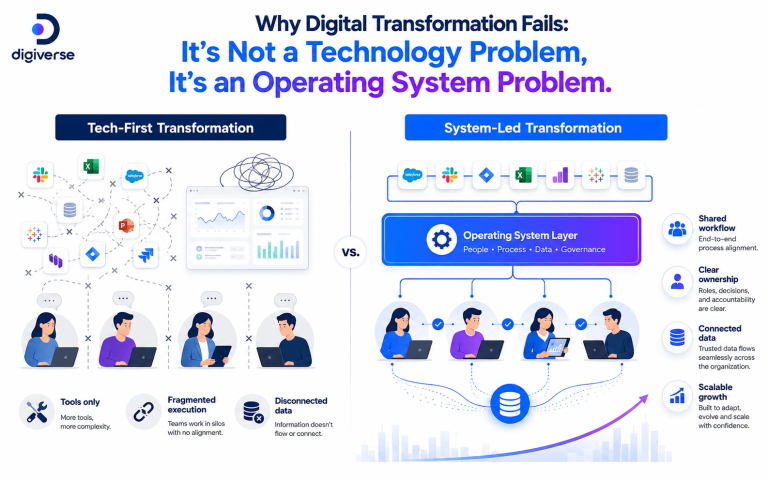
The problem is no longer a lack of tools or channels—it is the lack of a unified Operating System.
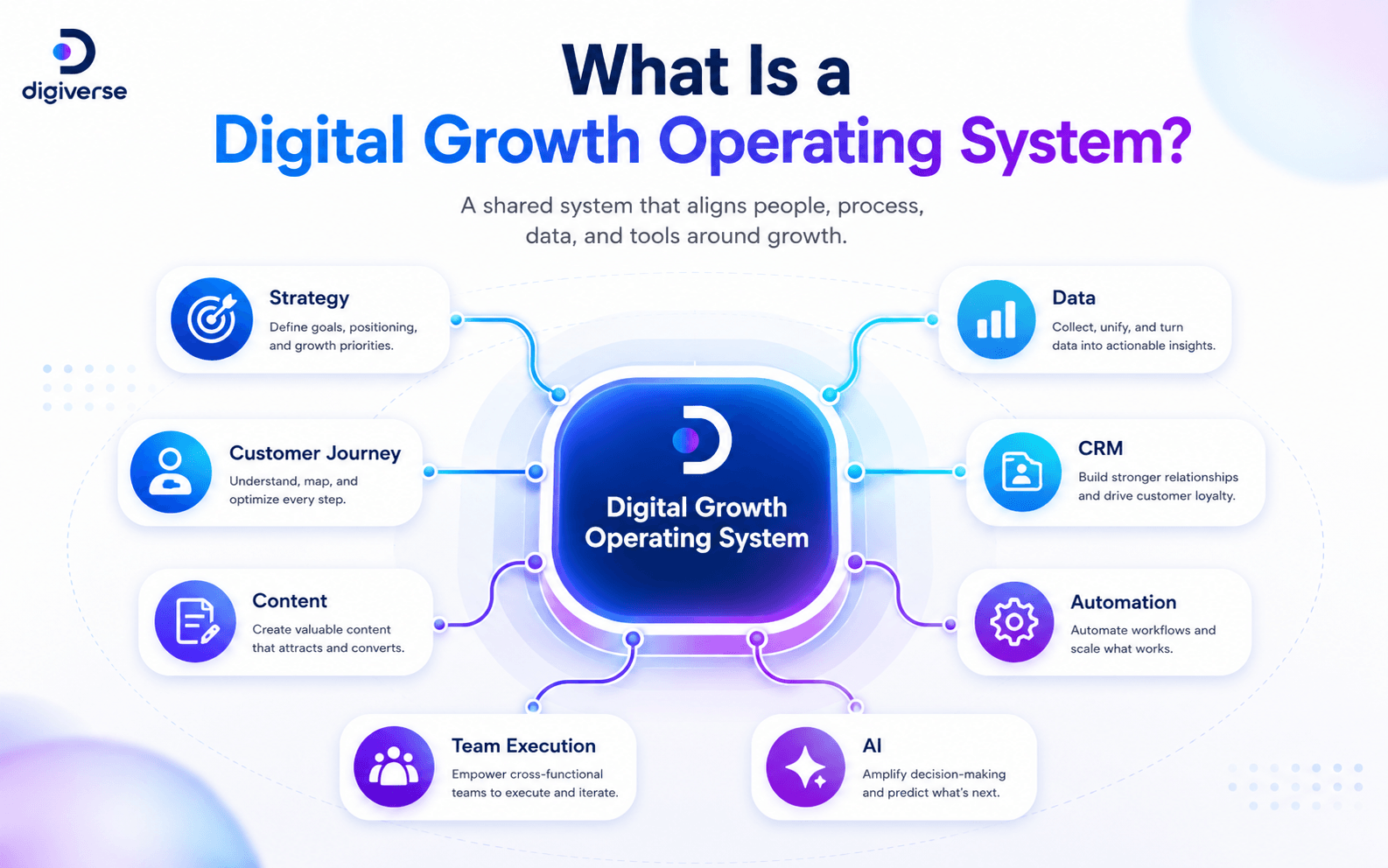
A Digital Growth Operating System is a framework that connects strategy, touchpoints, data, tools, people, and operational processes to drive growth in an organized manner. Put simply, it is the answer to the question: Is your marketing operating as a growth system, or are you just managing a series of disjointed tasks?
Why Is This Important?
Modern marketing is no longer just about communication. It is increasingly intertwined with revenue, lead quality, customer experience, data, commerce, and operational efficiency. Without a clear operating system, teams risk working harder without achieving better results.
A campaign may generate engagement but fail to create genuine demand. A channel may increase traffic but fail to convert. A CRM program may send many messages but fail to drive retention. A dashboard may show many metrics but fail to point to the next actionable step. A Digital Growth Operating System helps businesses avoid the trap of “siloed teams, misaligned channel goals, and disconnected data.”
What Is Changing?
-
Marketing is No Longer a Standalone Department: Marketing must work in tandem with sales to understand lead quality, with customer service to capture post-purchase feedback, with data teams to analyze behavioral signals, and with operations to create seamless experiences. Without a shared system, each team optimizes its own work while the overall customer journey remains broken.
-
The Multi-Touchpoint Customer Journey: Customers don’t just see one ad and buy. They interact through social media, search, video, messaging, consultations, in-store visits, reviews, and post-purchase care. An Operating System allows businesses to view these as a unified journey rather than isolated channels.
-
Turning Data into Action: Businesses have an abundance of data from ads, websites, CRMs, and social channels. However, data does not create decisions on its own. Without a process for analyzing and acting on this information, data remains buried in reports.
-
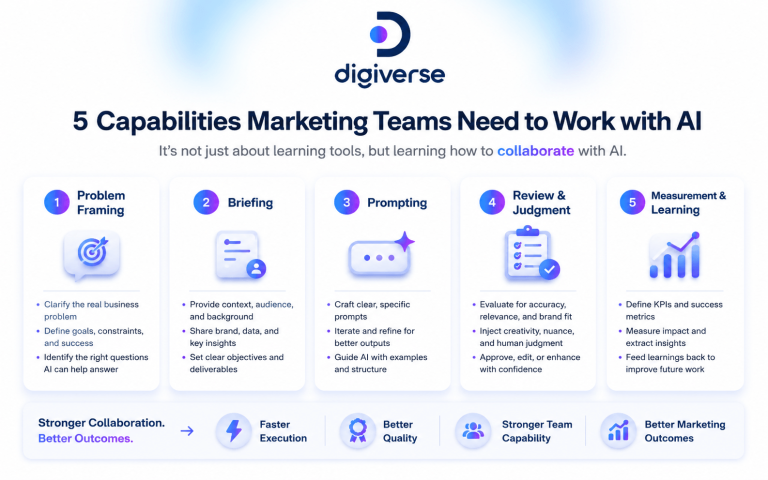
AI Heightens the Need for Process: AI helps teams work faster, but higher speed requires more rigorous control. If AI assists with content, you need brand voice standards; if it assists with data, you need input validation; if it assists with support, you need clear hand-off protocols to human agents. The more powerful the AI, the more critical the operating system.
The Digiverse Perspective: The Six Pillars
Digiverse believes that a Digital Growth Operating System is not a single piece of software, but the way a business organizes its entire digital operation to serve growth. It connects six core components:
-
Growth Objectives
-
Customer Journey
-
Content and Communication System
-
Data and Measurement
-
Tools and Technology
-
Process and Ownership
When these six pillars are integrated, marketing evolves from a series of disconnected activities into a system that is purposeful, data-informed, accountable, and scalable.
5-Step Framework for Building Your Operating System
-
Identify the Core Growth Problem: Start with the business goal: Do you need to generate more demand, improve lead quality, bridge the gap between marketing and sales, reactivate old customers, or connect online/offline experiences?
-
Map Touchpoints and Breakpoints: Visualize the entire customer and internal operational journey. Where does the customer meet the brand? Where is data stored? Is data being reused to improve the next interaction?
-
Design a “Minimum Viable” Operating System: Don’t build an overly complex system from day one. Start with one growth goal, one primary customer journey, a critical set of data points, a few key channels, and a regular cadence of collaboration.
-
Integrate Data into the Operational Rhythm: Incorporate data into weekly or monthly syncs. Teams should collectively review performance, identify where customers are dropping off, decide which customers to nurture, and determine what lessons should be applied to the next cycle.
-
Standardize to Scale: Once the system works, standardize repetitive tasks: planning, brief-writing, measurement, data interpretation, AI usage, and lead hand-off protocols.
Implications for Businesses in Vietnam
In Vietnam, many businesses are scaling their digital operations rapidly, but sometimes their operational maturity lags behind their speed. A brand may manage many social channels but lack a content system; a company may run performance ads but fail to measure lead quality.
The opportunity lies in reconnecting existing activities. A Digital Growth Operating System helps businesses move from simply “doing digital” to “operating digital growth.”
Self-Audit Checklist
-
[ ] Do we have a clear growth objective before launching digital activities?
-
[ ] Are our marketing activities mapped to the customer journey?
-
[ ] Are our content, ads, CRM, sales, and data efforts connected?
-
[ ] Is data used to drive decisions, or just to report numbers?
-
[ ] Is there clear ownership for every critical touchpoint?
-
[ ] Are AI and automation governed by clear processes?