Opening Insight
For many years, businesses have invested heavily in digital.
-
You have websites.
-
You have Fanpages.
-
You have TikTok accounts.
-
You run advertisements.
-
You have a CRM.
-
You have chatbots.
-
You have email marketing.
-
You have dashboards.
-
You have AI tools.
-
You have automation systems.
-
You have social listening.
-
You have landing pages.
-
You have apps or e-commerce platforms.
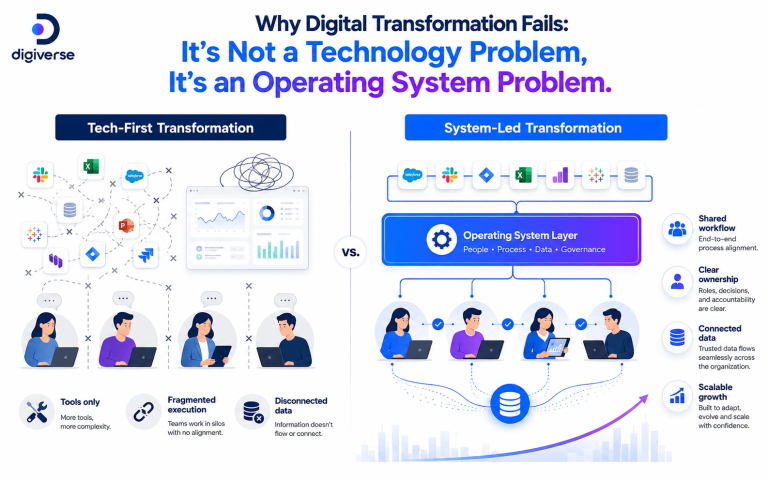
On the surface, it seems like your digital transformation is complete. However, in reality, many systems are still operating in silos.
-
Content is produced consistently but isn’t connected to the customer journey.
-
Ads generate leads, but the leads aren’t nurtured in a timely manner.
-
The CRM holds data, but it isn’t used for personalization.
-
Chatbots respond quickly but fail to hand over to humans at the right moment.
-
Dashboards display many metrics, but they don’t lead to actionable decisions.
-
AI is used to create content, but there is no quality control process.
-
Digital channels run in parallel but fail to create a seamless experience.
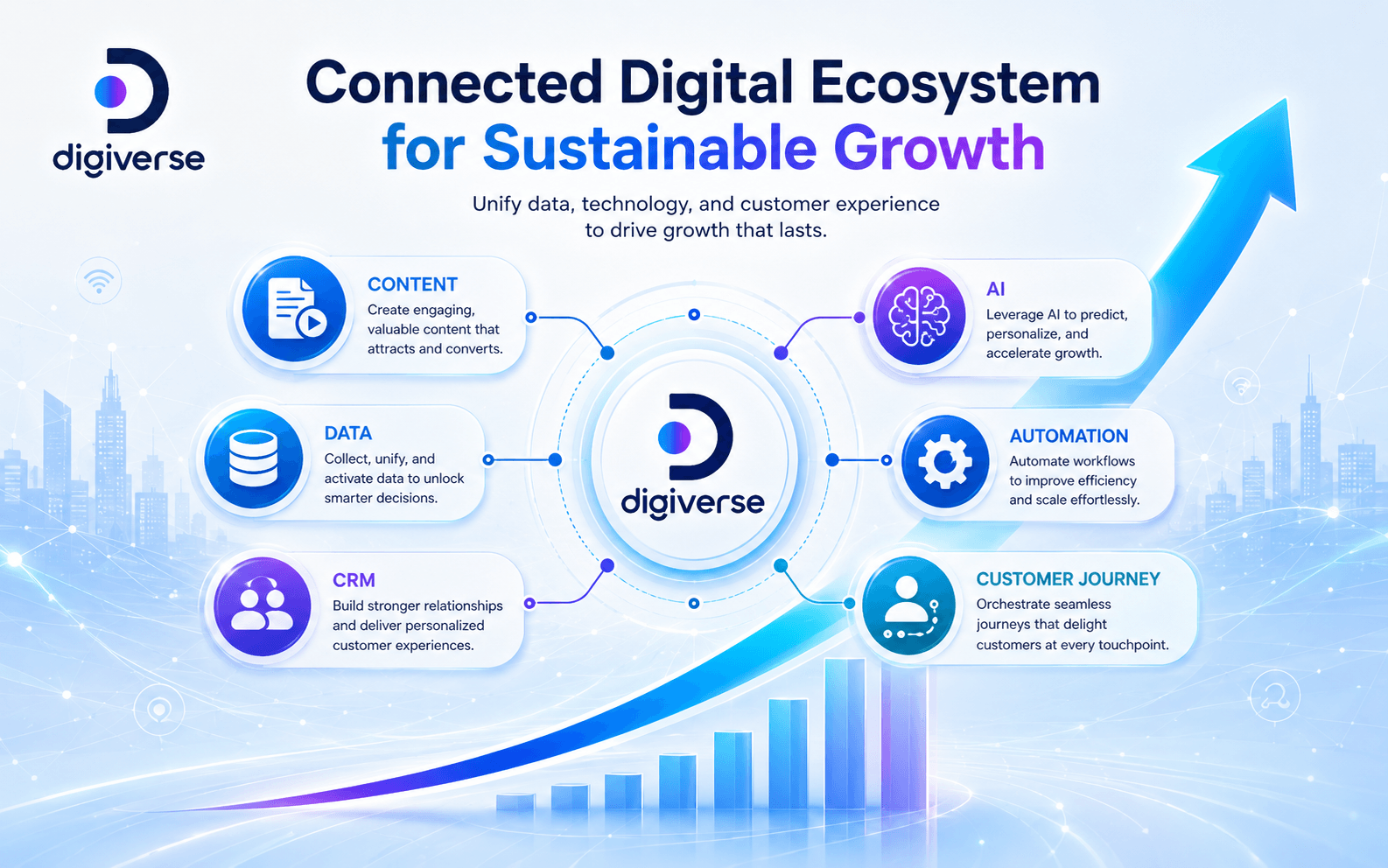
This is a very common problem: businesses have many digital touchpoints but lack a connected digital ecosystem. A connected digital ecosystem isn’t just about having many tools; it is about how a business links channels, data, content, processes, and people so that customers can navigate a clear journey while the team operates more efficiently.
Put simply, the question is no longer how many digital tools a business has. The better question is: Are those tools and channels working together to drive growth?
Why is this important?
Customers today do not interact with a business through a single channel. They might discover a brand through a short video, read more on a website, check reviews from creators, send a message for information, leave a lead form, receive nurture emails, get a call from sales, make a purchase online or offline, and then continue to be nurtured via CRM, Zalo, email, or community.
To the customer, this is a continuous journey. But to the business, that journey is often fragmented:
-
The Social team focuses on engagement.
-
The Media team focuses on ad metrics.
-
The Content team focuses on the posting calendar.
-
The Sales team focuses on the lead list.
-
The CRM team focuses on customer data.
-
The Customer Service team focuses on post-purchase feedback.
-
The Operations team focuses on order processing.
If these teams do not view the same journey, the customer experience will be disjointed:
-
Customers leave information but are never contacted.
-
Customers have already purchased but continue to receive “new customer” ads.
-
Customers provide negative feedback but still receive promotional messages.
-
Customers need deep consultation but only receive automated replies.
-
Customers interact multiple times, but the brand fails to recognize the signals of interest.
When the digital ecosystem is disconnected, businesses often do a lot of work, but growth does not follow. Conversely, when the ecosystem is connected, businesses can understand customers better, respond faster, personalize accurately, measure effectively, and optimize performance.
What is changing?
1. Digital is no longer just a support channel; it is the infrastructure for growth
Previously, digital was often viewed as a subset of communication—used to post, run ads, create awareness, or drive traffic. Today, digital has become the infrastructure of growth. It influences how customers discover a brand, research products, leave information, make purchases, receive care, and return. This means digital cannot operate as isolated channels; it must be organized as a system.
2. Customers expect a more seamless experience
Customers do not want to repeat information. They don’t want irrelevant messages. They don’t want to be moved from one channel to another while losing context. A seamless experience doesn’t come from one good channel; it comes from multiple connected touchpoints.
3. Data is more abundant but more fragmented
Businesses today have massive amounts of data, but it resides in many different places: ad data, website analytics, CRM data, chat logs, sales data, customer service history, and content performance reports. A connected digital ecosystem ensures data does not just serve reporting, but serves action.
4. AI increases the need for systemic organization
AI helps businesses move faster—writing content, analyzing data, generating ideas, and automating steps. But if the system is disorganized, AI can amplify that fragmentation. AI only creates sustainable value when placed within a digital ecosystem with clear goals, reliable data, refined processes, and oversight.
The Digiverse Perspective
At Digiverse, we believe a connected digital ecosystem should be built around growth goals, not a list of tools. Do not start by asking, “Which tools should we use?” Instead, ask:
-
What journey are our customers going through?
-
Where are the friction points?
-
What data needs to be connected?
-
What content guides the customer to the next step?
-
What actions should the CRM trigger?
-
Where should AI provide support?
-
Who is responsible for each touchpoint?
-
Which metrics indicate the system is creating value?
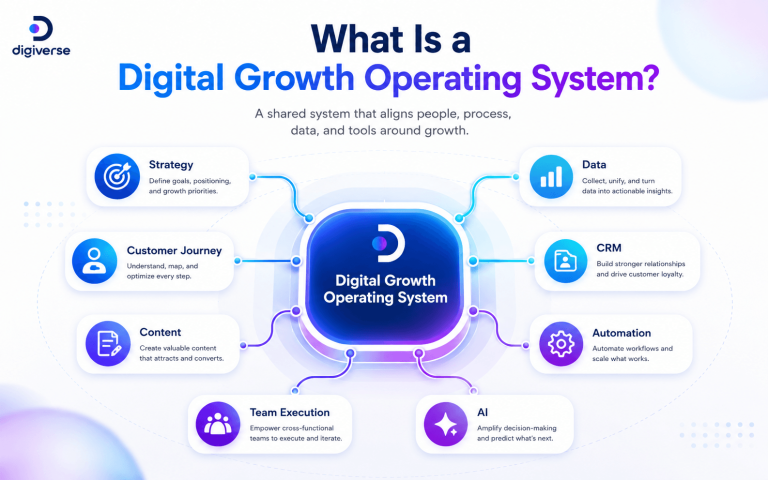
A connected digital ecosystem consists of six key layers:
-
Growth Strategy: Knowing what the ecosystem serves (awareness, leads, conversion, retention, or operational efficiency).
-
Customer Journey: Mapping touchpoints from awareness to consideration, action, and post-purchase.
-
Content & Channel System: Ensuring every piece of content leads the customer forward.
-
Data & CRM: Organizing data to maintain customer context and trigger appropriate actions.
-
Tools, AI & Automation: Technology should support, not replace, operational thinking.
-
Processes & Ownership: Every touchpoint requires a person in charge, a clear process, and a measured KPI.
The 6-Step Implementation Framework
-
Step 1: Define the core growth challenge. Don’t try to connect everything at once. Choose one crucial problem (e.g., improving lead quality, nurturing, or sales integration).
-
Step 2: Map the current customer journey. Identify where customers come from, where they drop off, and where the data silos exist.
-
Step 3: Identify critical break points. Prioritize fixing the points that most significantly impact growth.
-
Step 4: Connect data to action. Use data to trigger the next move—whether it’s a personalized email, a sales follow-up, or a reactivation campaign.
-
Step 5: Choose tools based on process, not trends. Tools should follow the strategy. An effective, simple CRM is better than a complex system that nobody knows how to operate.
-
Step 6: Establish a rhythm for measurement and improvement. The ecosystem is not a “one-and-done” project. Regularly review what is working and optimize based on data.
Self-Check Table: Is your digital ecosystem connected?
| Question | Yes/No |
| Do you know which growth goal your digital ecosystem serves? | |
| Are all digital channels mapped within a single customer journey? | |
| Does your content guide customers to the next step? | |
| Is data from social, website, CRM, sales, and CS connected? | |
| Is your CRM used to trigger actions rather than just store info? | |
| Is automation based on behavioral signals and context? | |
| Is there a clear handover point from chatbot to human? | |
| Is AI used within a controlled, supervised process? | |
| Is there a dedicated person responsible for each touchpoint? | |
| Do you have a periodic rhythm to measure and optimize? |
If many answers are “No,” you may have many digital activities, but lack a connected digital ecosystem.