Opening Perspective
Many businesses have started automating parts of their marketing, sales and customer service operations.
Emails are sent automatically.
Messages are triggered by user behavior.
Chatbots answer frequently asked questions.
CRM stores customer information.
Reports are updated regularly.
AI supports content creation and data summarization.
This is an important step forward. But having automation tools does not mean a business is already operating intelligently.
Automation only helps a system do predefined tasks faster. If the process is wrong, automation makes the mistake faster. If data is fragmented, automation sends messages without enough context. If the customer journey is unclear, automation may annoy customers instead of nurturing them.
Therefore, after having the tools, the more important question is: does the business know how to operate those tools within a growth system?
Why does this matter?
In the early stage, automation is often used to reduce manual work. This is a very practical need.
Businesses want to save time.
They want to respond to customers faster.
They want to reduce repetitive tasks.
They want to nurture customers more consistently.
They want measurement to be easier.
They want to scale without adding too many people.
However, as automation develops, businesses soon face a new issue: the tools may run, but the system may not create clear value.
An email sequence may be sent regularly, but response rates remain low.
A chatbot may answer many questions, but customers are still not satisfied.
A CRM may store a lot of data, but the team does not use that data to make decisions.
A dashboard may show many metrics, but no one knows what action should come next.
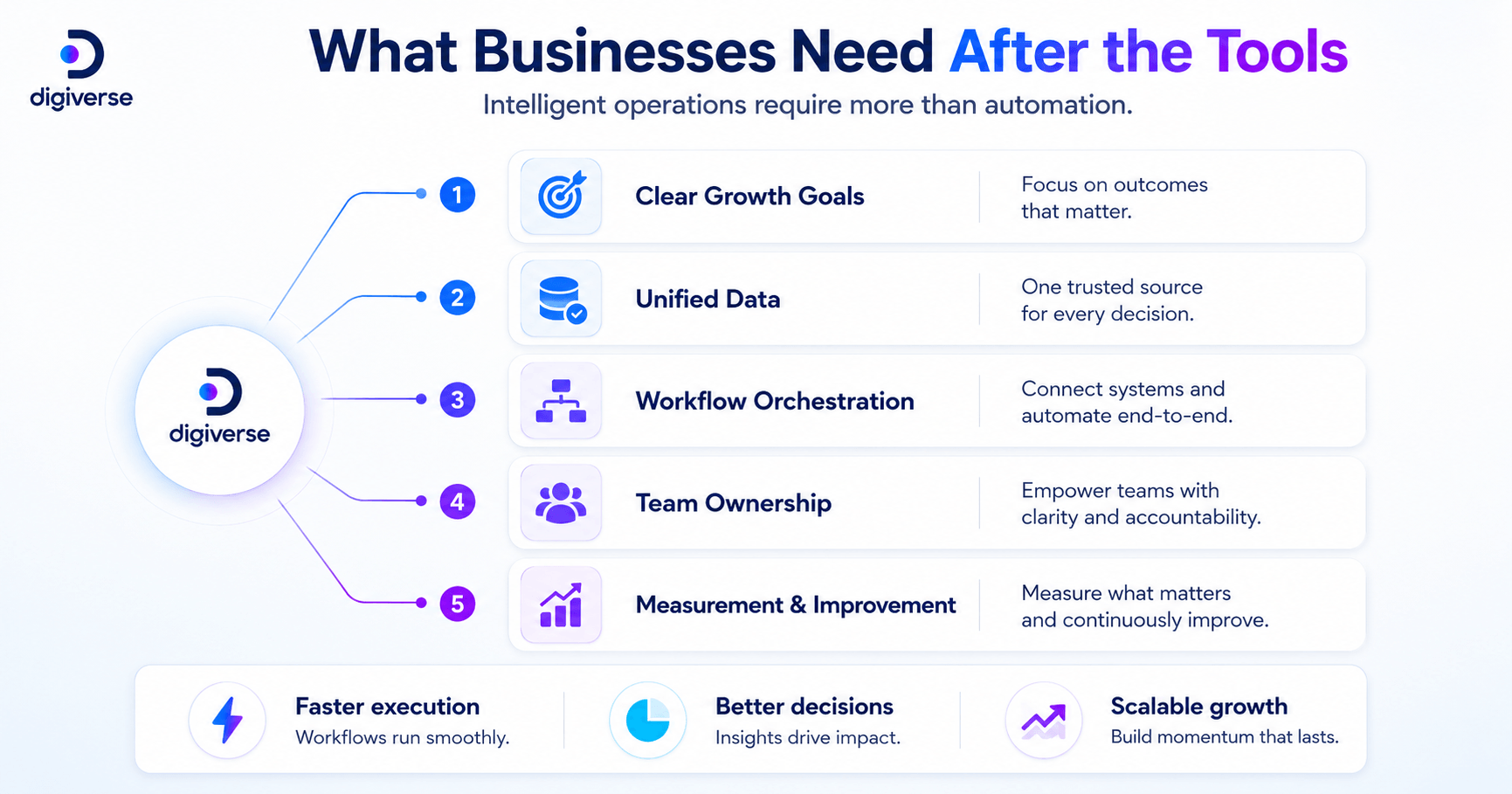
This shows that automation is only one part. Businesses need to move toward intelligent operations.
Intelligent operations mean the system does not only “run automatically.” It also knows how to use data to identify signals, trigger the right actions, hand over to humans when needed and improve continuously after each operating cycle.
What is changing?
1. Tools are becoming easier to access
In the past, automation often required complex systems and large budgets. Today, many businesses can access CRM, chatbots, email automation, social scheduling, analytics, AI writing tools and dashboards much more easily.
This helps businesses get started faster. But when everyone can use tools, the advantage no longer comes from “having tools.” The advantage lies in how the business uses them.
With the same CRM tool, one business may only use it to store information. Another may use it to design customer journeys, segment audiences, nurture customers, measure performance and optimize revenue.
The tool may be the same, but different operating capabilities create different results.
2. Automation needs contextual data
An automated system is only as good as the clarity of its input data.
Who is the customer?
Which stage are they in?
Which content have they interacted with?
Have they purchased before?
Are they being followed up by the sales team?
Have they given positive or negative feedback?
Are they showing interest, or are they inactive?
Without contextual data, automated systems can easily send the wrong message.
A customer who has just purchased should not receive the same message as someone who has not purchased.
A customer who has declined many times should not keep receiving the same offer.
A customer who needs consultation should not only receive generic automated replies.
Intelligent operations require data to be organized around the customer journey and business objectives.
3. AI raises expectations for operating systems
AI helps businesses handle many tasks faster: creating content, summarizing data, analyzing feedback, suggesting actions, personalizing messages and supporting customer service.
But AI also makes one issue clearer: if a business does not have a proper process, AI will struggle to create sustainable value.
AI needs a clear brief.
It needs accurate data.
It needs review standards.
It needs a brand voice.
It needs handover points to humans.
It needs a way to measure effectiveness after deployment.
AI does not replace the operating system. AI needs to be placed inside the operating system.
The Digiverse Perspective
From Digiverse’s point of view, businesses need to shift from “automating tasks” to “operating intelligently.”
Task automation focuses on the question: what can be done faster?
Intelligent operations focus on a deeper question: what action should the system take, based on which signal, at what time, for which customer group, and who is responsible for improving the result?
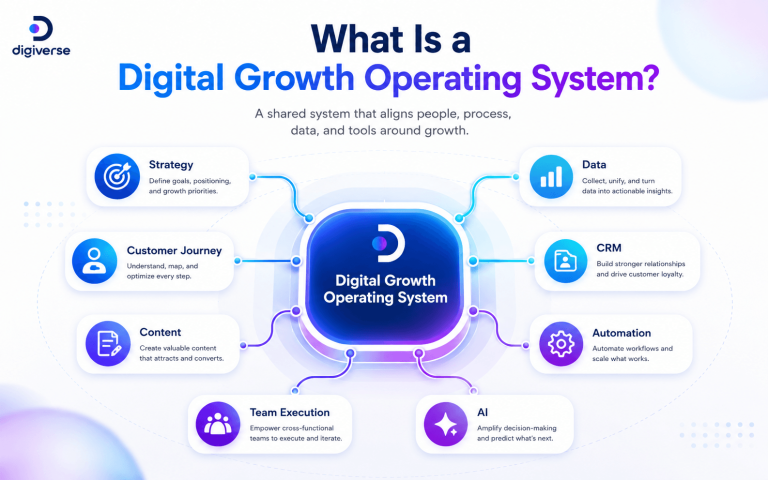
An intelligent operating system needs five layers:
Contextual data
Businesses need to know where customers are in the journey and which behaviors are meaningful.
Clear processes
The system needs to know when to start, when to stop, when to hand over and who is responsible.
Connected tools
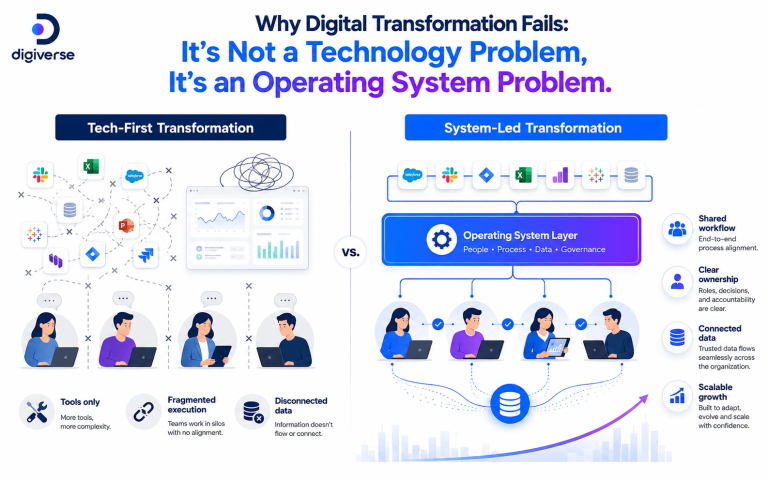
CRM, automation, chatbots, analytics, content and sales should not operate in silos.
Human control
People need to set goals, check quality, handle exceptions and make important decisions.
Continuous learning loop
The system needs to measure results, learn from them and improve the journey after each operating cycle.
Implementation Framework: 5 Steps to Move from Automation to Intelligent Operations
Step 1: Review the objective of each automation flow
Businesses need to define what each automation flow is meant to achieve.
Increase responses from potential customers?
Reduce drop-off after customers submit information?
Nurture customers after purchase?
Reactivate inactive customers?
Increase repurchase potential?
Reduce request handling time?
Without a clear objective, the system is simply running on schedule, not creating value.
Step 2: Review input data
Businesses need to check whether the current data is strong enough to support proper automation.
Are customer segments clearly defined?
Do you know which content customers have interacted with?
Do you know whether customers have purchased or not?
Do you know who is nurturing each customer?
Do you know which signals matter?
If the data is missing or fragmented, automation should be limited before it is scaled.
Step 3: Design trigger signals and stop signals
An intelligent system does not only know when to send. It also knows when to stop.
It should trigger when a customer submits information.
It should remind when a customer has not responded.
It should stop when a customer has purchased.
It should stop when a customer shows no interest.
It should hand over to humans when the customer needs consultation.
It should prioritize high-value customers.
Stop signals are just as important as start signals.
Step 4: Connect automation with CRM and the operating team
Automation should not stand alone.
When a customer shows an important signal, CRM should record it.
When a customer needs consultation, the right team should be notified.
When a customer has been contacted, the automated system should update the status.
When a customer gives negative feedback, there should be a different handling process.
Intelligent operations only happen when tools and people share the same system view.
Step 5: Measure action quality, not just task volume
Businesses should not only measure the number of emails sent, messages triggered or chatbot responses delivered.
They need to measure deeper:
Do customers respond?
Do they convert?
Are they receiving too many messages?
Do they unsubscribe?
Are they handed over at the right time?
Which groups respond better?
Which journeys need to be shortened or extended?
Intelligent operations mean operations that can learn and improve.
Meaning for Businesses in Vietnam
In Vietnam, many businesses have started using CRM, chatbots, email automation, Zalo OA, social inboxes, AI content tools and dashboards. This is a strong foundation for moving toward intelligent operations.
However, a common risk is that tools are implemented before the operating system is clearly designed.
A business may have CRM but no nurturing process.
It may have a chatbot but no handover point to a real person.
It may have email automation but no customer segmentation.
It may use AI for content creation but lack a brand voice and approval standards.
It may have a dashboard but no decision-making rhythm.
Vietnamese businesses can start by choosing one important journey, such as potential customers after submitting information, post-purchase customers, or inactive customers who need reactivation.
Then, they can redesign that journey based on intelligent operating logic: what data is needed, which signals should be tracked, which actions should be automated, where humans are needed, which metrics should be measured and what lessons should be updated.
Self-Audit Checklist
Does the business know what objective each automation flow serves?
Is the input data clear enough for accurate personalization?
Are there stop signals to avoid sending messages in the wrong context?
Is automation connected with CRM and sales?
Is there a handover point to humans when needed?
Does the business measure interaction quality instead of only message volume?
Is there a regular rhythm for reviewing and optimizing journeys?
Is AI used within a controlled process?
If many answers are “not clear yet,” the business may have automation tools, but not yet an intelligent operating system.
Call to Action
Automation helps businesses work faster. But intelligent operations help businesses work more accurately, learn faster and create more sustainable value.
If your business already has tools but does not yet know how to connect them into a clear operating system, Digiverse can help review the customer journey, data, processes, automation and measurement metrics to build a suitable intelligent operating model.