Opening Perspectives
When businesses think about “digital transformation,” they often fixate on technology:
-
Implementing a CRM.
-
Building a new website.
-
Using project management software.
-
Marketing automation.
-
Deploying chatbots.
-
Building dashboards.
-
Applying AI.
-
Connecting data silos.
-
Digitizing internal processes.
While these are important, having technology does not mean digital transformation is successful.
-
A CRM can be purchased, but if no one enters data correctly, it’s useless.
-
A dashboard can be built, but if no one uses it for decision-making, it’s just a picture.
-
A chatbot can be launched, but if it doesn’t improve customer satisfaction, it’s an annoyance.
-
An AI tool can be adopted, but if the output is uncontrolled and disconnected from business goals, it’s just noise.
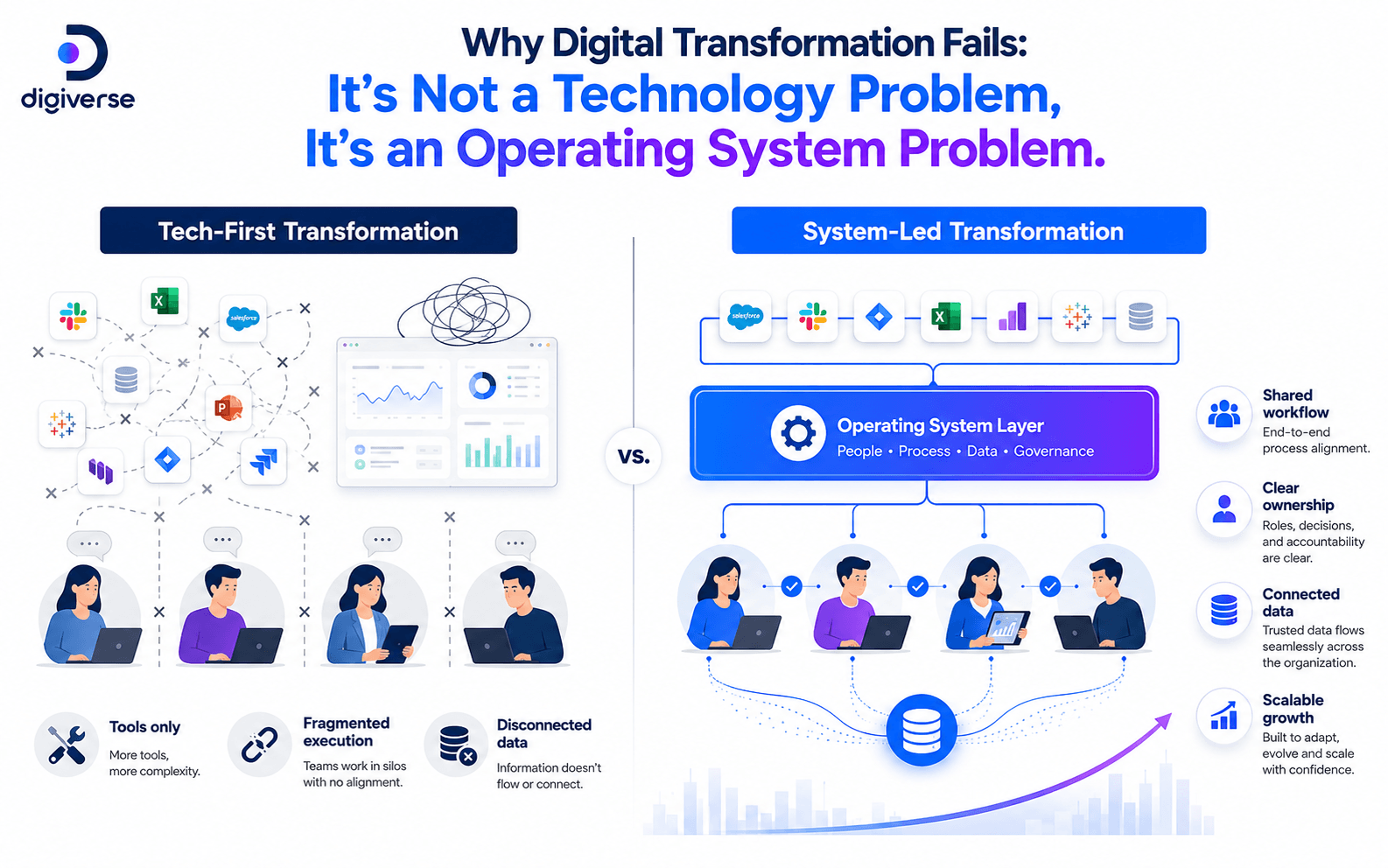
The problem is rarely the quality of the technology itself; it is whether the business has the operational system required for that technology to create value.
Why This Shift Is Critical
Digital transformation promises faster workflows, deeper customer insights, lower costs, and improved competitive advantages. Yet, many projects fail to meet expectations. This isn’t usually due to a lack of determination, modern tech, or team willingness—it’s the gap between “deploying tools” and “changing the way we operate.”
Tools are only one component. True value requires clear objectives, streamlined processes, connected data, trained personnel, clear ownership, and measurable outcomes. Without these, technology simply acts as a new layer over broken, legacy systems.
Common Reasons for Failure
1. Starting with Tools Instead of Business Problems
A common mistake is asking, “What software should we buy?” The correct question is: “What are we trying to improve?” Are you looking to boost revenue, reduce customer churn, automate manual tasks, or accelerate decision-making? Without a clear problem, tools are often selected incorrectly or implemented poorly.
2. Digitizing Broken Processes
Many projects simply move old, inefficient processes onto a new platform (e.g., moving Excel tasks to software). If the underlying process is flawed, digitizing it only makes it run faster—it doesn’t make it better. You must decide which steps to keep, which to discard, and which to automate or humanize.
3. Siloed Data
Digital transformation aims to enable data-driven decisions. However, when data is fragmented across marketing, sales, customer service, and finance, the business lacks a “single source of truth.” Decisions become fragmented and incomplete.
4. Lack of Operational Ownership
New tools need clear owners. Who manages the system? Who audits the data? Who turns reports into strategy? Who supports the team? Without defined ownership, tools are quickly abandoned or used inconsistently.
5. Poor Change Management
An automated system changes how people work. If the team hasn’t been prepared, doesn’t understand the “why,” or lacks support, they will view the new technology as an added burden rather than a facilitator.
The Digiverse Perspective: The Five Layers of Transformation
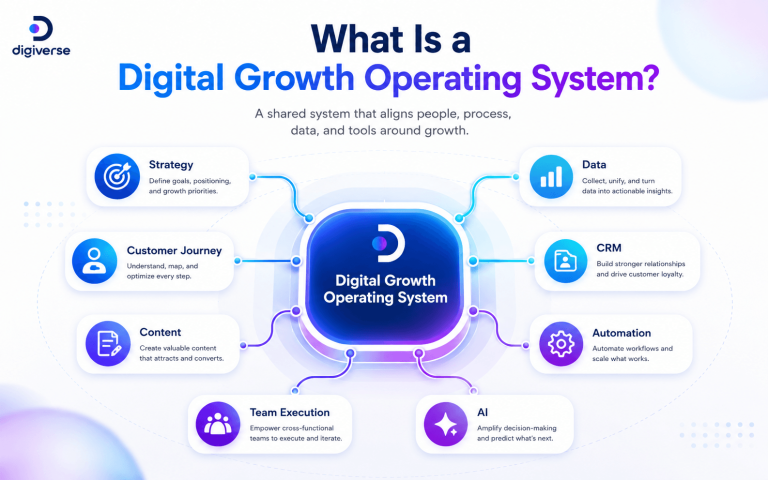
Digiverse views digital transformation not as an IT purchase, but as an operational redesign. Every project must be evaluated across five layers:
-
Business Objectives: Why are we doing this?
-
Journey & Process: How do customers and teams move through these steps?
-
Data: What do we need to capture, connect, and utilize?
-
Tools: Technology selected to serve the problem, not the trend.
-
People & Ownership: Training, role distribution, and operational accountability.
The 6-Question Framework for Getting Started
-
What are we trying to improve? Define a specific pain point (e.g., shortening lead response time).
-
Where is the process currently breaking? Map the current journey to find bottlenecks.
-
What data is truly necessary? Focus on data that drives decision-making.
-
Which tool fits the problem? Choose technology based on the process, not features or popularity.
-
Who is responsible for operations? Assign a system owner before the project begins.
-
How do we measure success? Define KPIs (e.g., reduced manual labor, higher conversion rates) before implementation.
Why This Matters for Businesses
In Vietnam, the push for digitalization—via CRM, AI, and automation—is strong. This is a positive signal, but the risk of failure remains high if the focus remains solely on the tools. A CRM will fail without clean data; an AI tool will fail without brand-aligned quality control.
Digital transformation is a continuous operational journey, not a short-term tech project. Start by choosing one clear problem, designing a lean process, assigning roles, and measuring tangible value.
Self-Audit Checklist
-
[ ] Do we have a clear objective for this transformation?
-
[ ] Have we mapped and redesigned our current process?
-
[ ] Is the bottleneck identified?
-
[ ] Have we determined which data is essential?
-
[ ] Are we choosing tools based on the problem, not trends?
-
[ ] Is there a dedicated system owner?
-
[ ] Is the team trained and supported?
-
[ ] Are there clear success metrics?
-
[ ] Is there a rhythm for optimization after deployment?
If you answered “not sure” to many of these, hold off on buying new tools. Focus on redesigning your operational system first.