Introduction: From Content Calendar to Market Intelligence
In many businesses, social media is managed as a simple content calendar. You post about the brand on Monday, the product on Tuesday, interactive content on the weekend, and promotional offers during sales seasons.
While this ensures a consistent brand presence, it doesn’t necessarily create clear business value. A Fanpage might post daily but yield no new insights. A TikTok channel might have thousands of views but no data on which content actually drives consideration. A post might have high engagement but provide no data on what customers truly care about.
Social media should not just be a platform for a brand to speak; it should be a place to listen, experiment, learn, and guide customers forward.
Why This Matters
Customers leave a wealth of signals on social media every day: what they interact with, what they comment on, what they share, what questions they ask, and how they compare you with competitors. If you only look at “vanity metrics” like likes or share counts, you miss the true market intelligence:
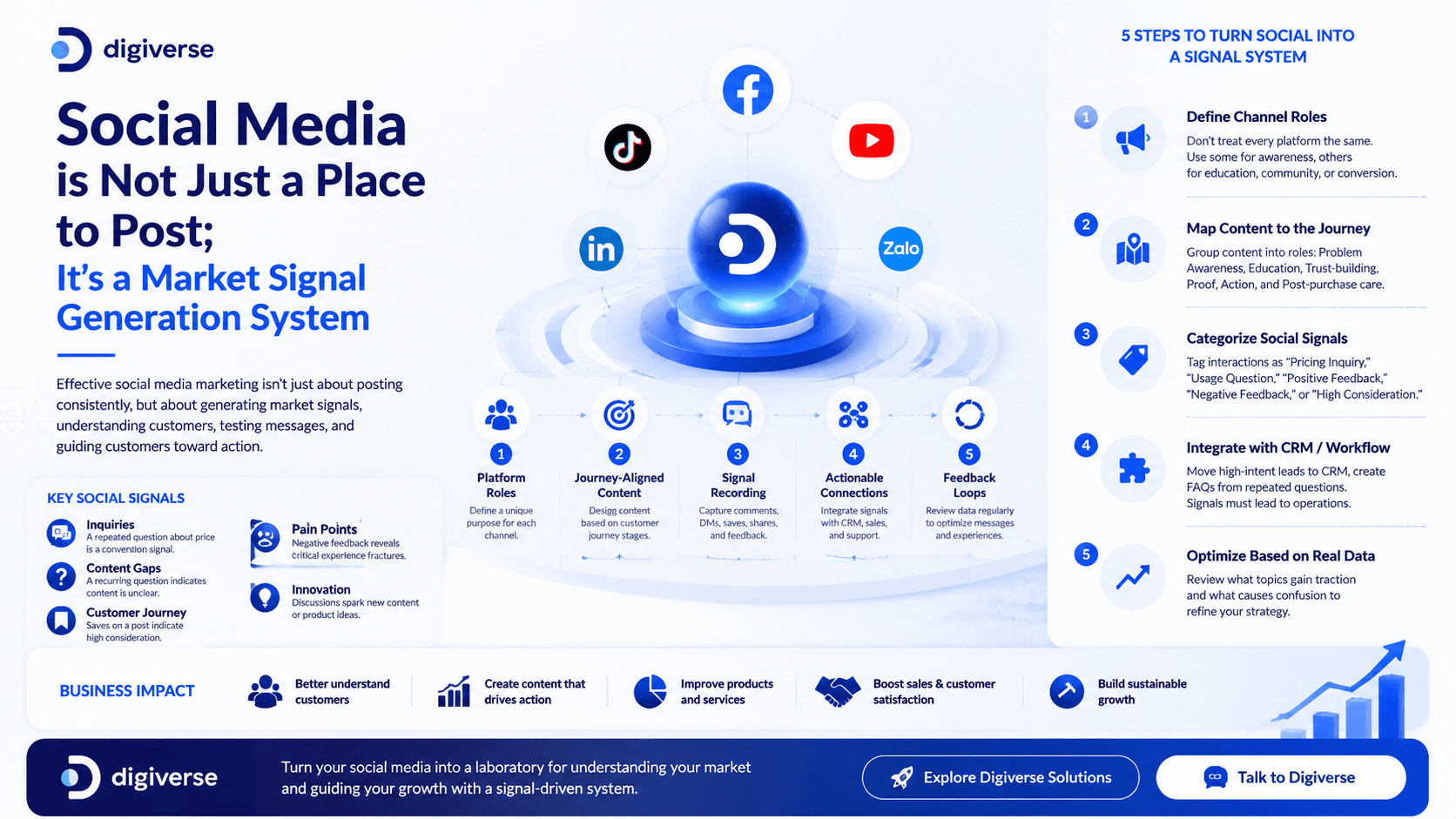
- Inquiries: A repeated question about price is a conversion signal.
- Content Gaps: A recurring question indicates your current content is unclear.
- Customer Journey: A cluster of “saves” on a specific post indicates high consideration.
- Pain Points: Negative feedback reveals critical fractures in the customer experience.
- Innovation: Frequent discussions about specific topics can spark new content or product ideas.
The Changing Landscape
- Beyond Awareness: Social media is no longer just for reach. It is a multi-functional pillar that builds awareness, explains problems, establishes trust, generates demand, collects feedback, supports customer service, and triggers CRM workflows.
- Role-Based Content: Not every post needs to sell, but every post must have a clear purpose in the customer journey—whether it’s problem recognition, education, building trust, triggering an inbox conversation, or closing a sale.
- Actionable Social Listening: Listening isn’t just about tracking mentions; it’s about asking: “What does this mean for our business?” The data must flow from social into your content strategy, sales scripts, product development, and brand messaging.
Digiverse Perspective: The 5 Layers of a Social Signal System
- Platform Roles: Define a unique purpose for Facebook, TikTok, LinkedIn, YouTube, and Zalo.
- Journey-Aligned Content: Design content based on where the customer is in their decision-making process.
- Signal Recording: Categorize comments, inbox messages, saves, shares, and feedback.
- Actionable Connections: Link social signals to CRM, sales, or support processes.
- Feedback Loops: Regularly review social data to optimize messages and experiences.
Implementation Framework: 5 Steps to Turn Social into a Signal System
- Step 1: Define Channel Roles: Don’t treat every platform the same. Use some for awareness, others for deep education, community building, or conversion.
- Step 2: Map Content to the Journey: Group content into roles: Problem Awareness, Education, Trust-building, Proof of Capability, Action-oriented, and Post-purchase care.
- Step 3: Categorize Social Signals: Don’t just report total likes. Tag interactions as “Pricing Inquiry,” “Usage Question,” “Positive Feedback,” “Negative Feedback,” or “High Consideration.”
- Step 4: Integrate with CRM/Workflow: If a lead shows high interest, move them to CRM. If a question is asked multiple times, create a FAQ piece. Social signals must lead to operations.
- Step 5: Optimize Based on Real Data: Periodically review which topics gain traction and which trigger misunderstandings to refine your overall strategy.
Implications for Businesses in Vietnam
In Vietnam, social media is the primary touchpoint between brands and customers. People inquire via inbox, leave comments, watch reviews, and compare options publicly. Businesses that treat social media as an operational source of data—rather than just a “posting channel”—gain a massive competitive edge. Start by creating a simple dashboard to classify social signals, and watch your social media transformation from a megaphone into a growth-driven data source.
Self-Assessment Checklist
- [ ] Does each social channel serve a specific business goal?
- [ ] Is content categorized by the customer journey stage?
- [ ] Do you tag and categorize inbox/comment signals?
- [ ] Are social signals linked to your CRM, sales, or customer service workflows?
- [ ] Do you use social media insights to improve your product or messaging?
- [ ] Do you measure the quality of signals, not just interactions?
- [ ] Is there a regular cadence for reviewing social data?
If you answered “not sure” to many of these, you are likely running a content calendar, not a market signal system.