Introduction: Beyond the First Name
Personalization is one of the most frequently discussed concepts in modern marketing. Many businesses start with simple tactics: inserting a customer’s name into an email subject line, sending offers based on past purchases, recommending related products, or segmenting audiences by basic demographics.
While these methods can be helpful, they are not true personalization.
- An email that uses the customer’s name but delivers irrelevant content is still the wrong message.
- An offer sent to the right segment but at the wrong time can still be annoying.
- An automated behavioral trigger that lacks context can make a customer feel surveilled.
- A product recommendation completely disconnected from current needs degrades trust.
Personalization is not about using tricks to make a message look private. Personalization is about making the interaction genuinely relevant.
Why Context Matters
Today’s customers expect brands to understand them. They do not want generic blasts, irrelevant promotions, or the burden of repeating information they’ve already provided. They resent being treated like strangers after multiple purchases, being bombarded to buy something they just bought, or being chased by ads that are no longer relevant.
When personalization is executed correctly, customers feel understood, and the interaction becomes useful. When done poorly, they feel annoyed, stalked, or processed by a soulless machine. Therefore, personalization is not just a technological challenge; it is fundamentally about customer experience and trust.
The Changing Landscape
- From Static Data to Behavioral Signals
Previously, personalization relied heavily on static demographics: age, gender, location, or job title. Today, behavioral data is far more critical.
What content did they consume? What products did they browse? Have they made a purchase yet? Did they submit a form? Have they been silent for months? Have they ever filed a complaint? Behavior almost always reflects real-time intent far better than demographic profiling.
- Timing is Everything
The exact same message can be perfect today and completely inappropriate tomorrow. A new prospect needs value education. A prospect in the consideration phase needs proof and trust signals. A recent buyer needs onboarding and post-purchase care. A dormant customer needs a compelling reason to return. An angry customer does not need a cross-sell promotion. Understanding timing is the backbone of contextual personalization.
- AI Deepens Personalization, But Doesn’t Replace Strategy
AI can analyze behaviors, generate content variations, suggest micro-segments, predict response rates, and optimize send times. However, AI does not inherently know your business’s customer care logic if you haven’t designed the journey. If the data is dirty, AI personalizes incorrectly. Without frequency caps, AI will spam your customers. AI amplifies personalization power, but strategy and human control are still mandatory.
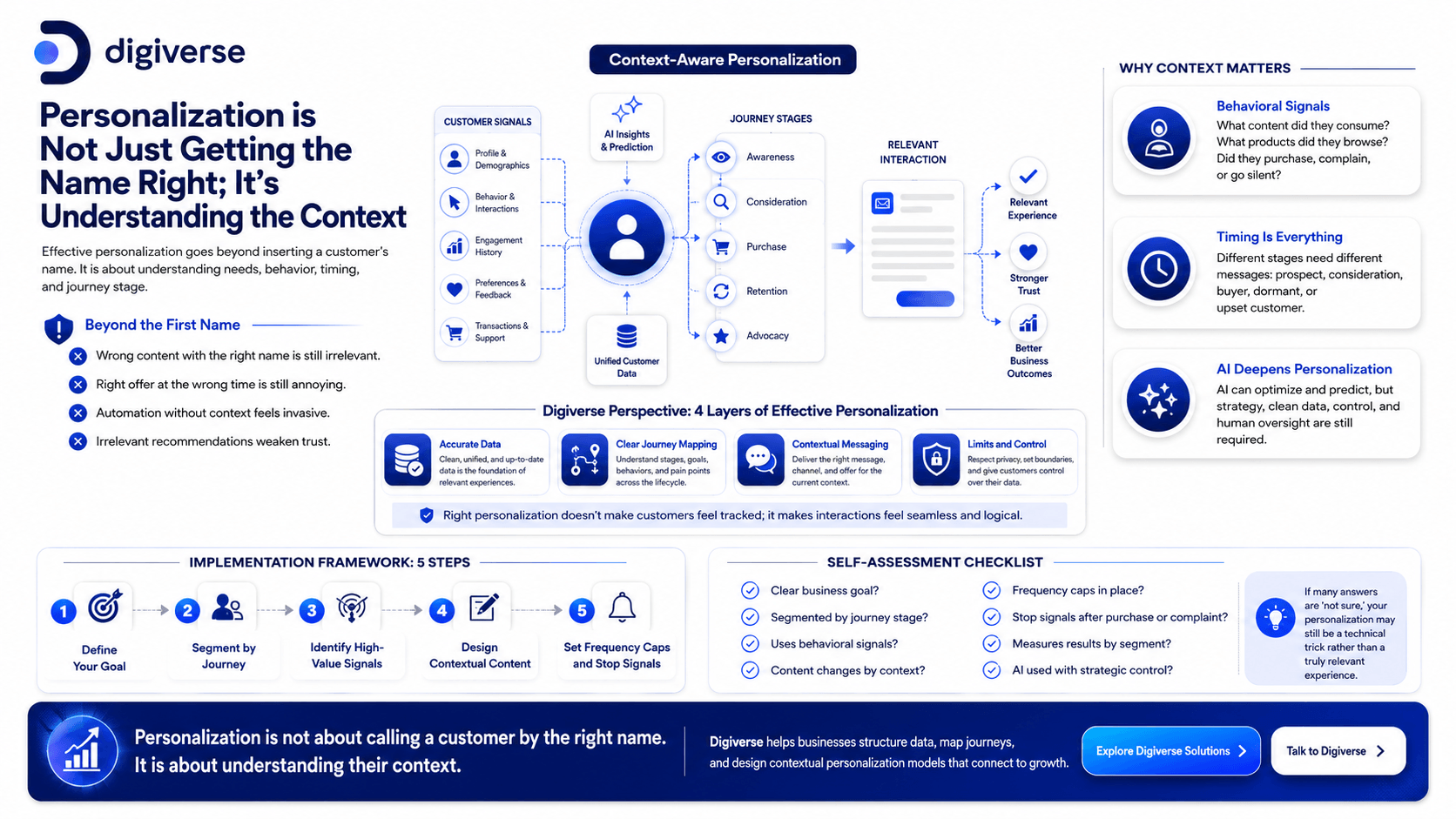
Digiverse Perspective: The 4 Layers of Effective Personalization
According to Digiverse, contextual personalization must be built on four foundational layers:
- Accurate Data: Comprehensive records of behavior, interaction history, purchase history, relationship status, and customer feedback.
- Clear Journey Mapping: Knowing exactly where the customer is—whether they are a new lead, a returning buyer, inactive, or at risk of churn.
- Contextual Messaging: Ditching the “one-size-fits-all” approach and tailoring the message to fit the specific stage of the journey.
- Limits and Control: Implementing frequency caps, definitive “stop” signals, and clear handover protocols from automation to human agents.
Right personalization doesn’t make customers feel tracked; it makes their interactions with your brand feel seamless and logical.
Implementation Framework: 5 Steps to Contextual Personalization
- Step 1: Define Your Goal: What are you trying to improve? Higher response rates? Better conversions? Increased retention? Reduced churn? Reactivation? Clear goals dictate which data and actions to prioritize.
- Step 2: Segment by Journey, Not Just Demographics: Move beyond age and location. Group customers by their status: New leads, in-consideration, first-time buyers, loyalists, dormant users, high-value clients, or those with negative feedback.
- Step 3: Identify High-Value Behavioral Signals: Determine which actions actually matter. Repeatedly viewing a specific product, abandoning a cart, downloading a whitepaper, or ignoring five consecutive emails are all vital signals that should trigger distinct responses.
- Step 4: Design Contextual Content: Don’t just swap out the [First Name] tag. Match the content to the customer’s specific problem, interest level, and preferred channel.
- Step 5: Set Frequency Caps and Stop Signals: Personalization does not mean sending more messages. Know when to stop: stop pitching when they buy, stop emailing if they don’t engage, and pause automation if they submit a complaint.
Implications for Businesses in Vietnam
In Vietnam, many businesses heavily utilize Zalo OA, SMS, email, chatbots, and retargeting ads to personalize interactions. This represents a massive opportunity, but it easily backfires without context. A customer who just bought a product is retargeted with a discount for the same item. A dormant customer receives a generic blast instead of a tailored reactivation offer.
Vietnamese businesses should start simple: segment your database into just three groups—New, Existing, and Dormant. Personalize your approach for these three distinct contexts before scaling up to complex behavioral triggers.
Self-Assessment Checklist
- [ ] Do you have a clear business goal for your personalization efforts?
- [ ] Are customers segmented by their journey stage rather than just demographics?
- [ ] Do you use behavioral signals to adjust your messaging dynamically?
- [ ] Is your personalized content genuinely different based on the customer’s context?
- [ ] Do you have frequency caps in place to prevent spamming?
- [ ] Are there “stop signals” that halt automated messages (e.g., after a purchase or complaint)?
- [ ] Do you measure response and conversion rates by specific segments?
- [ ] Is AI used within a controlled, strategic personalization framework?
If you answered “not sure” to many of these, your current personalization efforts may just be technical tricks rather than truly relevant experiences.