Introduction: Marketing as a Seamless Journey
In many organizations, marketing goals are compartmentalized: building brand awareness, increasing engagement, generating leads, driving conversions, providing post-purchase care, and increasing retention. However, if these objectives operate in silos, the business suffers:
- A great awareness campaign fails to drive action.
- High social engagement doesn’t support consideration.
- Lead generation ads aren’t followed up by sales effectively.
- High website traffic doesn’t translate into conversions due to a lack of trust-building content.
- Existing customers aren’t nurtured to return.
Full-funnel marketing is the practice of viewing marketing as a continuous journey rather than a series of disconnected activities.
Why This Matters
Customers rarely decide to purchase after a single touchpoint. They need to discover the brand, understand their problem, explore solutions, compare options, build trust, take action, and finally, be nurtured to stay loyal. If marketing focuses solely on awareness, you fail to convert. If you focus only on conversion, you ignore the necessary trust-building phase. If you only look for new customers, you bleed revenue by failing to retain existing ones.
The Changing Landscape
- Non-Linear Journeys: Customers don’t follow a straight line. They might watch a video, read a review, search for alternatives, visit your site, message your support team, go silent, and return weeks later. Full-funnel marketing maps the entire path rather than obsessing over a single touchpoint.
- Role-Specific Content: One-size-fits-all messaging doesn’t work. You need content for every stage: Problem-solving for awareness, deep-dive evidence for consideration, clear value propositions for conversion, and educational care for retention.
- Data-Driven Connectivity: If data is siloed by channel, you can’t identify where a customer is in their journey. Full-funnel marketing requires data bridges between content, ads, CRM, sales, and customer service.
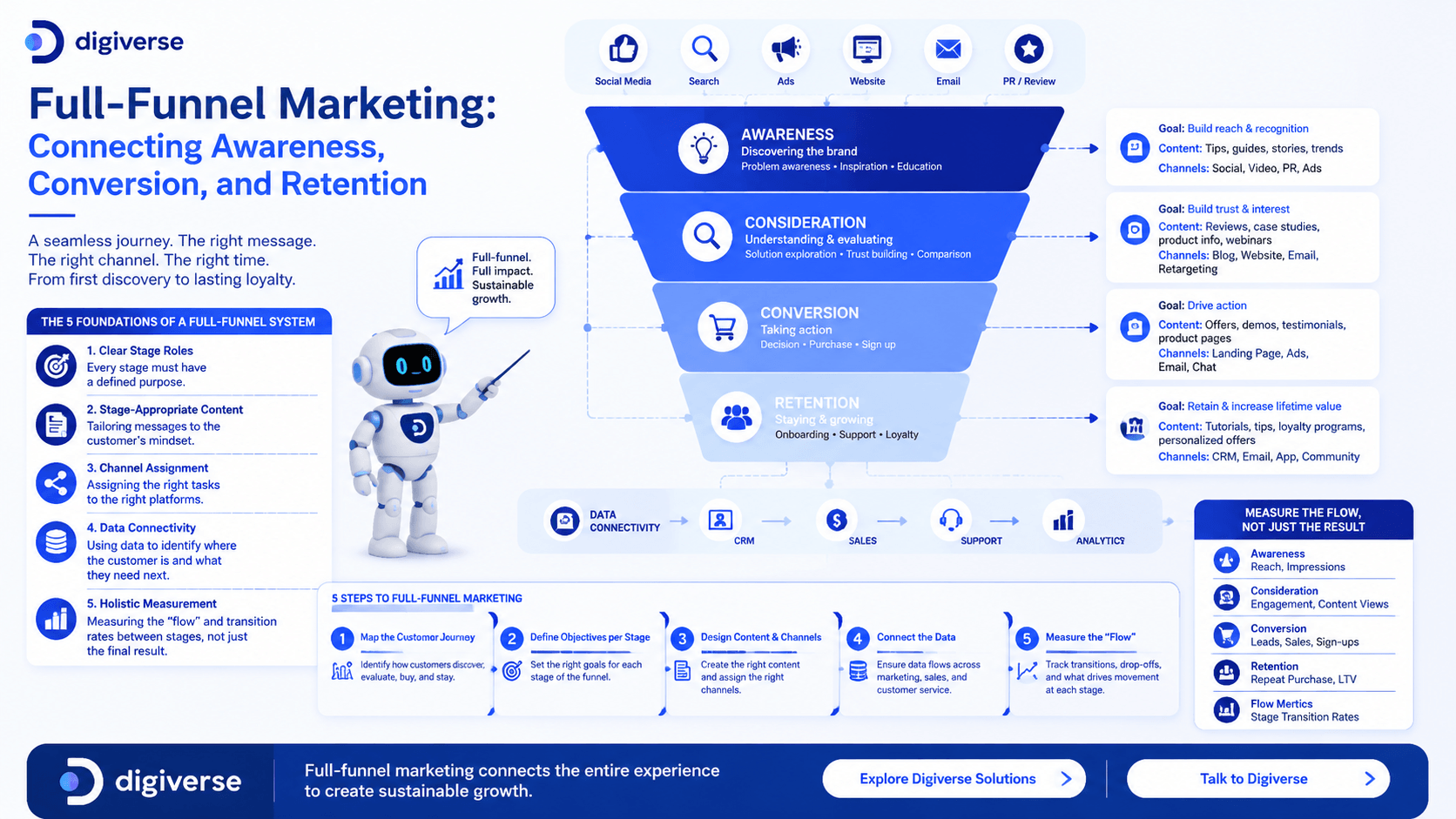
Digiverse Perspective: The 5 Foundations of a Full-Funnel System
- Clear Stage Roles: Every stage must have a defined purpose.
- Stage-Appropriate Content: Tailoring messages to the customer’s mindset.
- Channel Assignment: Assigning the right tasks to the right platforms.
- Data Connectivity: Using data to identify where the customer is and what they need next.
- Holistic Measurement: Measuring the “flow” and transition rates between stages, not just the final result.
Implementation Framework: 5 Steps to Full-Funnel Marketing
- Step 1: Map the Customer Journey: Identify how customers discover you, what information they need to trust you, what triggers their decision, and what keeps them coming back.
- Step 2: Define Objectives per Stage: Do not measure awareness by conversion metrics or vice versa. Optimize for success at each specific step.
- Step 3: Design Content and Channels: Align your channels (e.g., Social for Awareness, Blog for Education, Landing Page for Conversion, CRM for Retention).
- Step 4: Connect the Data: Ensure that leads from ads flow into your CRM, and sales/support signals flow back into your marketing system.
- Step 5: Measure the “Flow”: Track how many people move from awareness to consideration, which content builds the most trust, and where customers drop off.
Implications for Businesses in Vietnam
In Vietnam, marketing departments are often split into fragments: Social Media handles engagement, Media buys ads, Sales chases closing, and CRM handles support. This structural disconnection causes breaks in the funnel. Businesses can start by choosing one core product or service and re-designing its entire journey from discovery to repurchase. Start simple; the priority is ensuring these activities communicate with each other.
Self-Assessment Checklist
- [ ] Is the customer journey mapped out clearly?
- [ ] Does every stage have its own specific objectives?
- [ ] Is content tailored to each stage of the funnel?
- [ ] Are your channels assigned clear, specific roles?
- [ ] Is your data connected from awareness through to post-purchase?
- [ ] Do sales teams get clear context on where a lead is in their journey?
- [ ] Do you track the transition rates between funnel stages?
If you answered “not sure” to many of these, you may be performing many marketing tasks, but you are not running a full-funnel system.