Introduction: Beyond the “Prompt”
AI has become an essential companion for content teams. Writers use it for ideation, managers for outlining, social media teams for captions, and SEO specialists for headlines. While AI undoubtedly makes teams faster, speed is not synonymous with quality.
When individuals use AI spontaneously without a structured approach, the output becomes generic, inconsistent, and disconnected from brand identity. The question is no longer “Should we use AI?” but rather, “What process ensures that AI makes us faster, more consistent, and remains true to our brand?” Moving from random prompting to a controlled creative system is the next crucial step for content teams.
Why Strategy Matters
AI is a powerful amplifier, but it amplifies what you feed it. If your brief is weak, your brand voice is undefined, or your editorial standards are loose, AI will merely generate high volumes of mediocre content.
Risks of unmanaged AI use include:
- Loss of Brand Voice: Content sounds robotic or inconsistent.
- Strategy Drift: Producing more content that fails to serve business goals.
- Accuracy Issues: AI may hallucinate or cite incorrect data.
- Generic Outputs: Content fails to distinguish the brand from competitors.
The Evolution: What is Changing?
- From Tasks to Ecosystems: AI now enables teams to design entire content ecosystems. A single core message can be scaled into blogs, social posts, emails, and video scripts, ensuring a unified narrative across all channels.
- Prompts as Operational Assets: Instead of “personal habits,” prompts should be treated as organizational assets. Building a library of standardized, high-performance prompts ensures consistent quality across the entire team.
- Brand Voice as a North Star: As AI increases content volume, brand distinctiveness is the only competitive advantage. A strong brand voice—knowing what you say and, just as importantly, what you don’t say—is more critical than ever.
- Editorial Control as a Process: AI generates the draft, but humans must ensure the strategy, facts, tone, and context are impeccable.
Digiverse Perspective: The Content Operating System
AI should not replace content creators; it should liberate them from repetitive tasks to focus on strategy and creativity. A well-designed AI workflow integrates seamlessly with your customer journey, data analytics, and distribution channels.
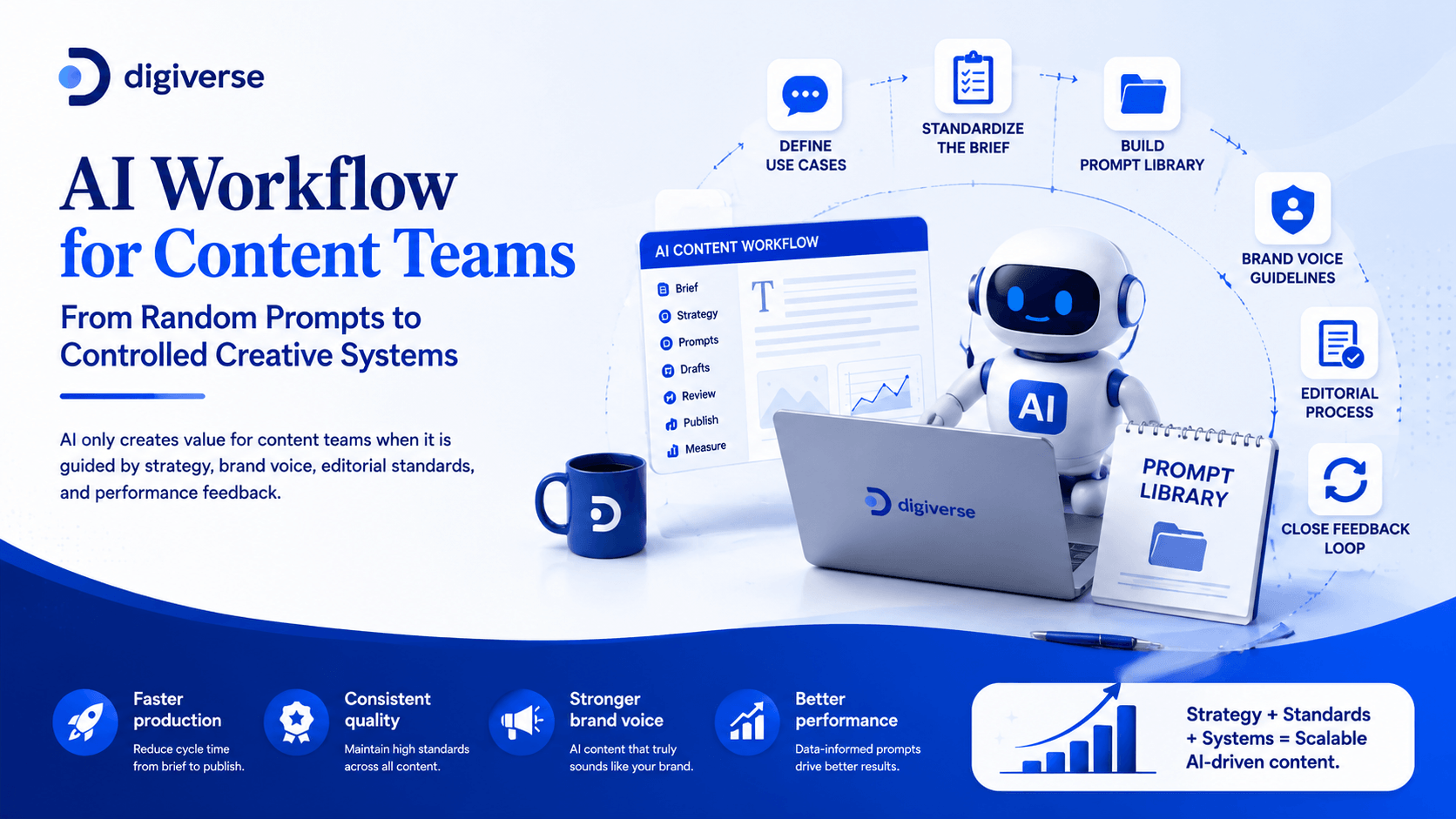
Implementation Framework: 6 Steps to Build an AI Workflow
- Step 1: Define AI Use Cases: Identify specific stages where AI adds value (e.g., brainstorming, outlining, drafting, or summarizing feedback).
- Step 2: Standardize the Brief: AI needs context. A good brief must include goals, target audience, brand perspective, SEO keywords, and “things to avoid.”
- Step 3: Build a Prompt Library: Create and categorize prompts for specific needs (SEO blogging, social captions, tone conversion, etc.).
- Step 4: Develop Brand Voice Guidelines: Clearly define the brand’s persona, vocabulary preferences, and how it handles complex topics.
- Step 5: Establish an Editorial Process: Every AI-assisted piece must pass through a human check for accuracy, strategy, and tone.
- Step 6: Close the Feedback Loop: Use post-publication data (click-through rates, reading time) to refine prompts and improve future output.
Implications for Businesses in Vietnam
Content teams in Vietnam are under pressure to produce more, faster, and in more formats. Without a standard, AI risks creating an endless stream of “commodity content.” To succeed, start small: define your brand voice, create a standard brief template, formalize your 5-10 most-used prompts, and implement a mandatory review checklist.
Self-Assessment Checklist
- [ ] Does the team have defined use cases for AI?
- [ ] Is there a standardized brief template?
- [ ] Do you have an internal library of validated prompts?
- [ ] Are there clear brand voice guidelines?
- [ ] Is there a checklist for editorial and fact-checking?
- [ ] Is there a clear distinction between what AI creates and what humans decide?
- [ ] Do you measure content performance and update prompts based on data?
- [ ] Is there someone responsible for managing the AI-content process?
If you answered “not sure” to many of these, you are likely using AI as a personal gadget rather than an operational capability.