Opening Insight
When marketing automation is mentioned, many businesses immediately think of automated emails, bulk messages, or pre-set customer care sequences. This is true, but it is only a small piece of the puzzle.
Marketing automation should not be interpreted as “sending more.” If misused, automation can lead to customers feeling pestered, receiving irrelevant information, and quickly losing affinity for the brand.
A customer who just made a purchase should not continue receiving messages intended for a prospect. A customer who has been inactive for a long time should not receive the same content as a highly engaged one. A customer who has requested a consultation should not have to wait too long for a response. A customer who has rejected an offer multiple times should not continue to be targeted with the same message.
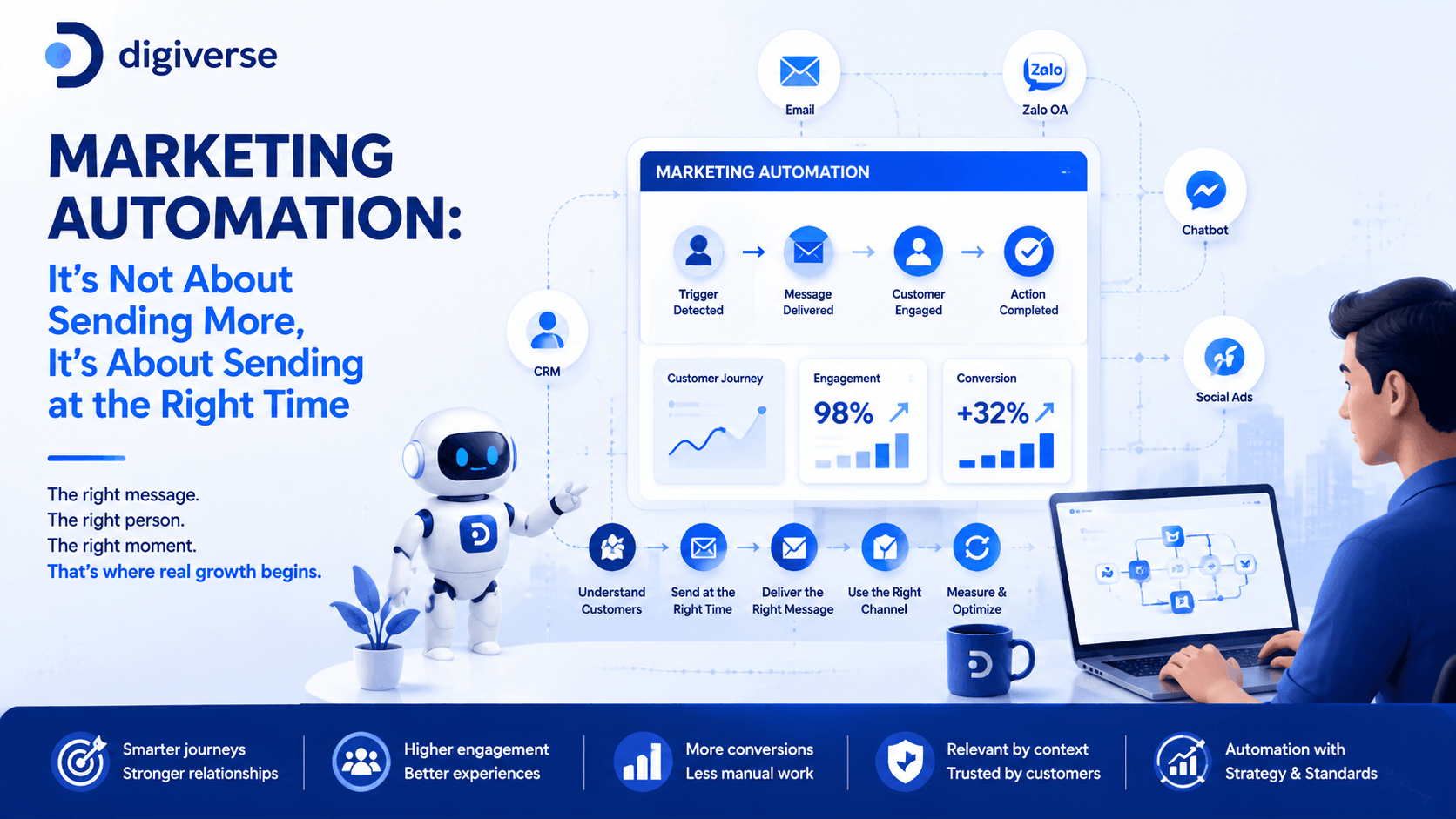
The true value of marketing automation does not lie in the volume of messages sent. It lies in the business knowing when to interact, with whom, with what message, and through which channel.
In other words, good automation doesn’t make a brand speak more; it helps a brand speak at the right time.
Why Is This Important?
Customers today are overwhelmed by brand communications: promotional emails, service messages, app notifications, retargeting ads, chatbot interactions, and social media content.
When brands send too much irrelevant information, customers start ignoring it. Worse, they may unsubscribe, block notifications, or feel that the brand does not understand them at all.
This is the major risk of marketing automation. While it expands a business’s ability to interact, without a clear strategy, it also expands the capacity to be a nuisance. A high-quality automation system must help businesses segment customers by behavior and stage, interact at the right time, implement reasonable frequency caps, adjust content based on context, connect data to action, and measure interaction quality—not just volume.
When done right, marketing automation makes the customer experience seamless. When done wrong, it makes the customer feel like they are being fed into a cold, heartless messaging machine.
What Is Changing?
- Customers Expect Relevance, Not Just Speed
Previously, receiving an automated response was a “plus.” Today, customers expect more. They want information tailored to their needs, they want the brand to remember their past interactions, and they want messages aligned with their current journey stage.
- Behavioral Data Is the Foundation of Automation
An automated sequence is only effective when based on accurate data. Businesses need to know what content a customer viewed, whether they provided contact info, if they purchased, which messages they engaged with, how long they have been silent, and if they have provided negative feedback. Without behavioral data, automation is just mass marketing in modern clothing.
- Automation Must Connect with CRM and Sales
Marketing automation should not exist in a silo. If a customer leaves their information, the system must pass it to the appropriate team. If a customer has already been contacted by sales, the automated sequence must be paused or adjusted. Without this integration, the customer experiences a disjointed journey.
- AI Enhances Personalization, But Requires Control
AI can help generate message variants, suggest send times, analyze behavior, and predict churn. However, AI cannot replace customer care logic. If the business lacks clear segmentation, AI will struggle to personalize correctly. Without frequency caps, AI might cause the brand to over-message. Without a defined brand voice, the messaging may lack consistency.
The Digiverse Perspective
At Digiverse, we view marketing automation as an integral part of the customer growth system. It is not just a messaging tool; it is a way to design recurring interactions that remain contextual, goal-oriented, and measurable.
An effective marketing automation system consists of five layers:
- Customer Journey
- Customer Segmentation
- Trigger and Suppression Signals
- Appropriate Content and Channels
- Measurement and Optimization
When these five layers are clear, automation ceases to be a “sending schedule” and becomes a system for timely, empathetic customer care.
Implementation Framework: 5 Steps to Marketing Automation
- Step 1: Define the Goal: Before setting up automation, know what you want to improve: lead response rates, reducing churn after lead generation, post-purchase care, re-engaging inactive users, or timely sales handoffs.
- Step 2: Choose the Right Segment: Target specific groups—new subscribers, shoppers who abandoned their cart, first-time buyers, inactive users, high-value customers, or those needing consultation.
- Step 3: Define Triggers and Suppression Signals: Many systems focus only on the start. You must know when to trigger, when to nudge, when to stop because the customer converted, and when to hand off to a human.
- Step 4: Contextual Content Design: Don’t be generic. A new customer needs value education; a lead considering a purchase needs a reason to trust; a buyer needs guidance; an inactive user needs a relevant reason to return.
- Step 5: Measure Quality, Not Quantity: Analyze if the automation is truly effective: Did it lead to conversions? Did it trigger high unsubscribe rates? Did we over-send? Which groups responded best?
Implications for Businesses in Vietnam
In Vietnam, many businesses utilize email, SMS, Zalo OA, chatbots, and CRM to manage customers. This is a necessary direction, especially when looking to scale without increasing manual overhead. However, the common risk remains: implementing automation as a simple “message calendar” rather than a true customer journey.
Self-Check Table:
- Does every automated journey serve a specific goal?
- Are customers clearly segmented before receiving messages?
- Are triggers based on real behaviors?
- Are there “stop signals” to prevent irrelevant messaging?
- Are there frequency caps in place?
- Is automation connected to CRM and sales systems?
- Is there a clear handoff to human staff when needed?
- Are we measuring conversion and quality rather than just send volume?