Campaigns Are No Longer the End Goal
For years, digital marketing has largely operated through a campaign-based model. There is a brief, an idea, a media plan, a content calendar, and an end-of-campaign report. Once the campaign concludes, the team reviews the KPIs and moves on to the next one.
While this approach remains necessary, it is no longer sufficient. Customers do not interact with a brand according to a campaign schedule. They might watch a video today, read a review next week, send an inquiry in a month, and visit the website multiple times before finally making a purchase. If a business only views marketing through the lens of individual campaigns, many critical customer signals are lost.
Campaign Thinking Creates Activity; Ecosystem Thinking Creates Assets
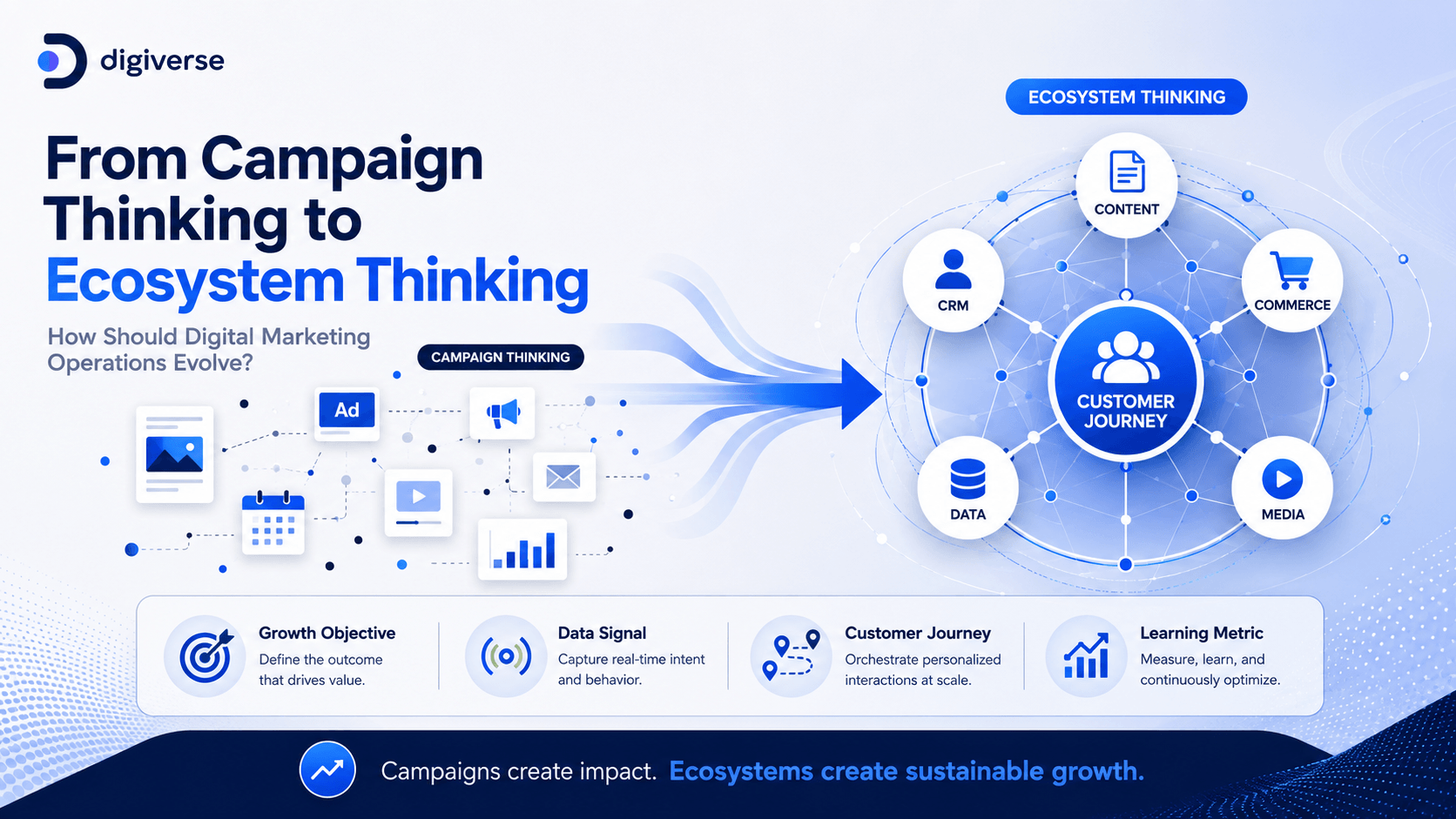
“Campaign thinking” focuses on the question: “What should we do to ensure this campaign hits its KPIs?” Conversely, “Ecosystem thinking” asks: “What does this campaign leave behind for our growth system?”
A successful campaign should do more than just generate reach or engagement. It should produce audience data, insights into messaging effectiveness, lists of potential leads, interest signals, reusable content assets, and learning for the next optimization cycle. If, after a campaign, a business is left with nothing but a report—with no new data, refined journeys, audience pools, or actionable playbooks—the campaign may have created activity, but it failed to build growth assets.
What Changes When Moving to Ecosystem Thinking?
Businesses begin to design campaigns as integral parts of a larger system. Content is no longer just for posting; it acts as a guide leading customers from awareness to consideration. Paid media is not just for buying traffic; it is used to test demand and build audience segments. CRM is not just for sending blasts post-campaign; it continuously nurtures customers based on their behavior. Dashboards do not merely record results; they identify specific areas for improvement.
This shifts the marketing focus away from a reliance on short-term “bursts” toward a capacity for learning, accumulation, and continuous optimization.
The Digiverse Perspective
At Digiverse, we do not view campaigns and ecosystems as mutually exclusive. Campaigns are still vital, but they must be positioned within a digital growth ecosystem. Each campaign needs a defined role within the system: generating demand, activating customers, driving conversions, collecting signals, or expanding institutional learning.
Application Framework
Before launching a campaign, define these four layers:
- Growth Objective: Which growth problem does this campaign solve?
- Data Signal: What data signals will it generate?
- Customer Journey: How does it connect to the post-interaction customer journey?
- Learning Metric: How will the team measure the insights gained?
After the campaign ends, do not just ask: “Did we meet our KPIs?” Ask instead: “How has our system become smarter because of this?”