Full-Funnel Is More Than Running Media Across Tiers
Many businesses interpret “full-funnel” simply as splitting campaigns into awareness, consideration, and conversion phases. While this is technically correct, it is insufficient. Full-funnel digital growth is not just about allocating budgets across funnel stages; it is about designing a journey where each stage prepares the data, trust, and motivation for the next.
Awareness is not just for brand visibility—it must generate signals of interest. Consideration is not just for content consumption—it must build trust and resolve barriers. Conversion is not just about a CTA—it must reduce friction and facilitate action. Retention is not just about sending offers—it must nurture relationships and increase customer lifetime value.
Why Is Full-Funnel Important?
Customers rarely make decisions after seeing a single advertisement. They interact with various content, multiple channels, review sources, and social signals before taking action. This makes measurement difficult if a business only focuses on “last-click” attribution or individual channel KPIs. Full-funnel growth enables businesses to view the entire journey, from the moment a customer first learns about the brand to the point where they become a repeat customer.
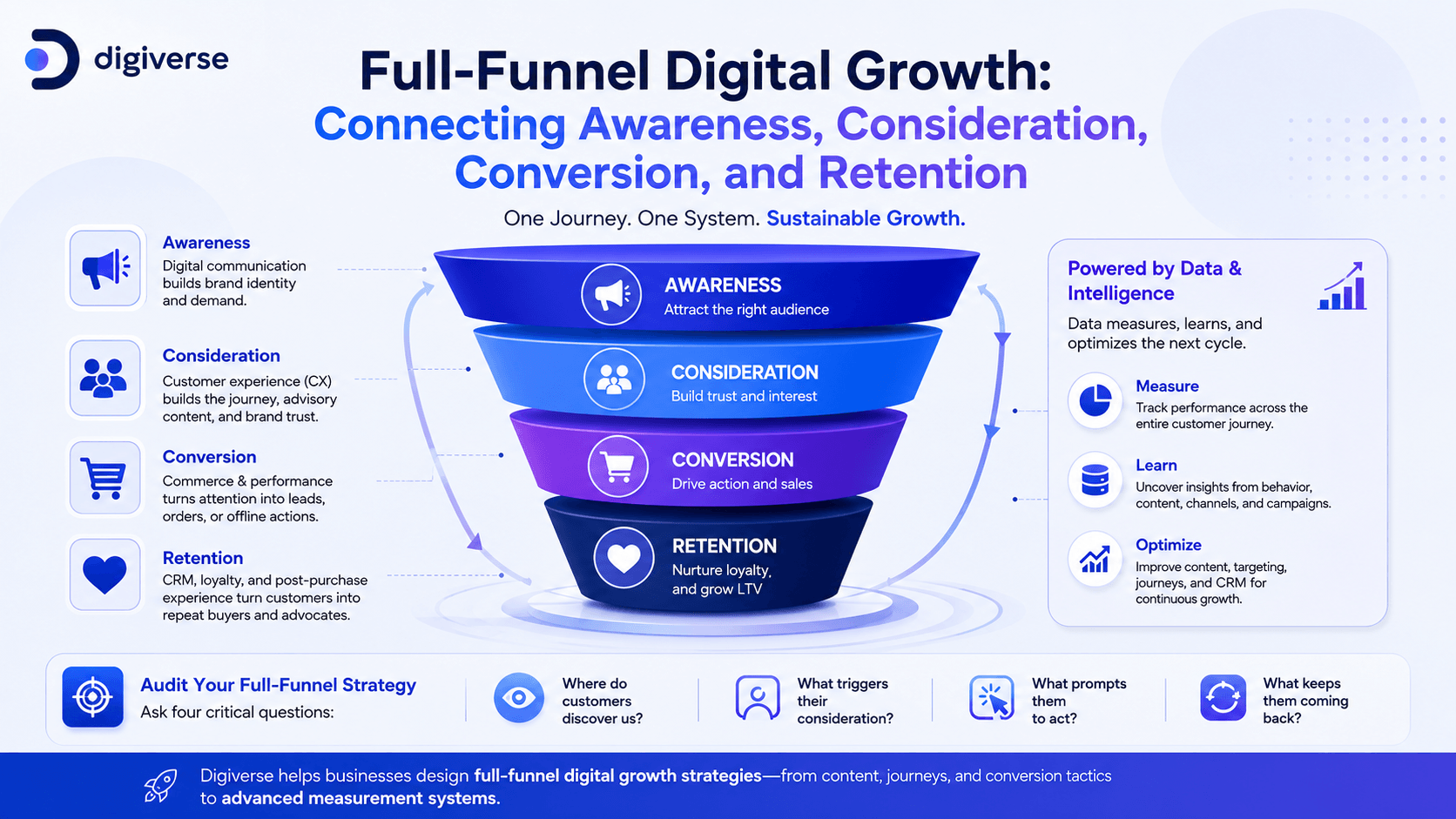
The Digiverse Model: Communication → CX → Commerce → Data
- Awareness: Digital Communication builds brand identity and demand.
- Consideration: Customer Experience (CX) builds the journey, advisory content, and brand trust.
- Conversion: Commerce & Performance turns attention into leads, orders, or offline actions.
- Data & Intelligence: Data measures, learns, and optimizes the next cycle.
The key differentiator here is the learning loop. An effective full-funnel system does not end at conversion. It utilizes conversion data to continuously improve content, audience targeting, the customer journey, and CRM efforts.
Application Framework
Businesses can self-audit their full-funnel strategy by asking four questions:
- Where do customers discover us?
- What triggers their consideration?
- What prompts them to act?
- What keeps them coming back?
If each of these questions is answered by a different team without cross-functional integration, your full-funnel approach is still just a diagram, not a working system.