Introduction: From Presence to Leadership
Many businesses are investing heavily in content: social media posts, short-form videos, blogs, emails, landing pages, ad copies, and customer service scripts. However, having a lot of content does not mean you have a content system.
A content calendar ensures you stay active, but it doesn’t necessarily lead the customer anywhere. An engaging video might rack up views without connecting to a conversion path. An SEO article might bring in traffic, but if it lacks a clear next step, that traffic is wasted.
When you only focus on the calendar, you are merely “present.” When you build a system, you are “leading.” A content system transforms your output from “posting to stay visible” into “designing to guide.”
Why This Matters
Customers don’t make decisions after consuming a single piece of content. They need a sequence: realizing they have a problem, understanding its importance, discovering your solution, comparing alternatives, building trust, finding proof, and being nudged toward action.
Without a system, you lose customers at every gap:
- Social media captures attention but lacks deep-dive explanations.
- Blogs provide information but lack a clear Call to Action (CTA).
- Landing pages present offers but lack trust-building evidence.
- Emails are sent on a schedule, not based on customer behavior.
The Changing Landscape
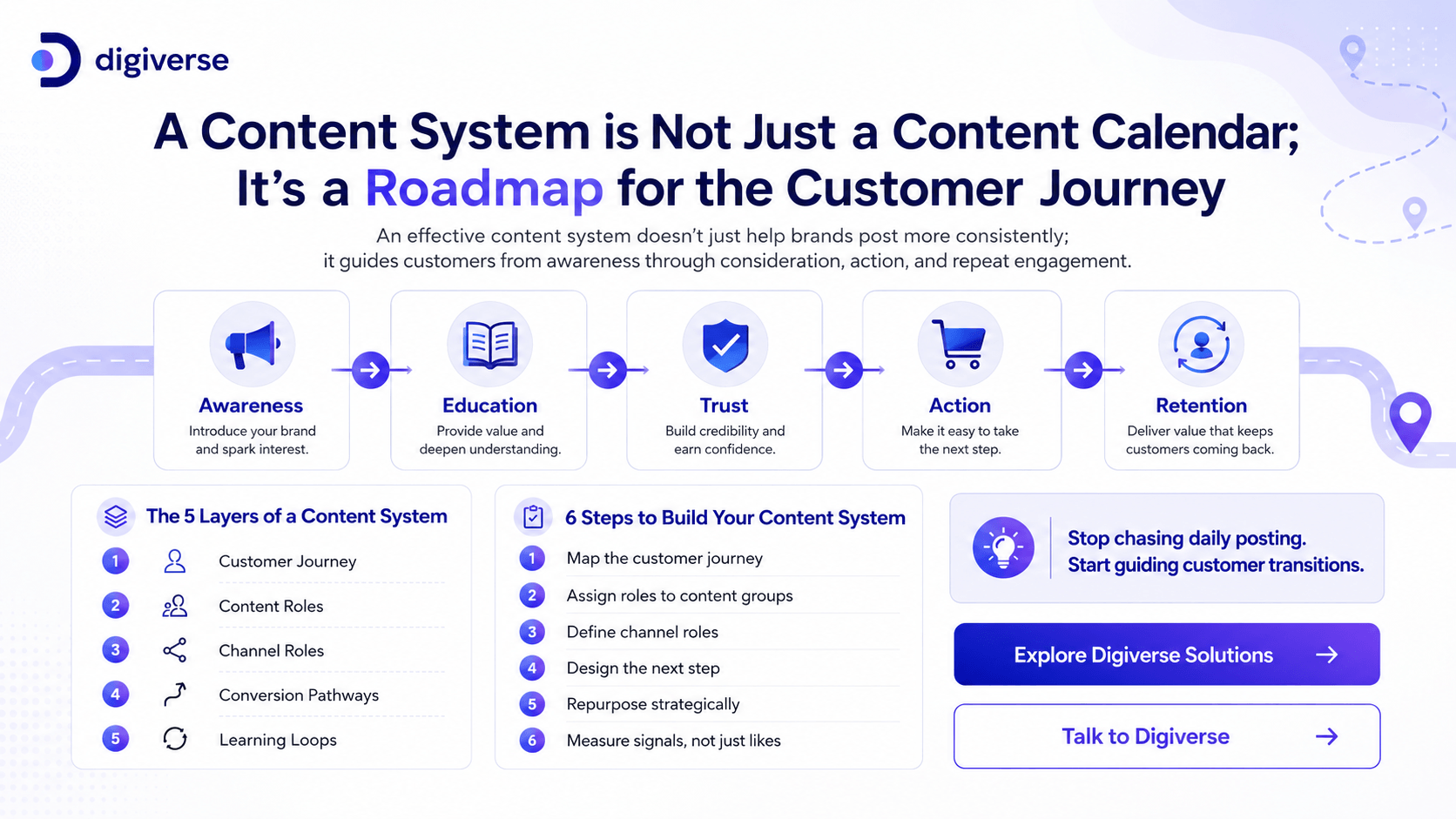
- Content Must Mirror the Journey: Instead of organizing by channel (e.g., “What to post on Facebook today?”), organize by the customer journey: Awareness, Consideration, Trust-building, Action, and Post-purchase care. This defines what to create and why.
- Strategic Channel Assignment: Not all channels are equal. Use social media for awareness, blogs for deep-dive education and SEO, emails for nurturing, and landing pages for conversion. Avoid the mistake of “carpet-bombing” all channels with the same message.
- AI Needs Strategy: AI makes content production faster, but it also increases the risk of generic, “commodity content.” Use AI to fuel your system, not replace the strategy. You must decide what needs personalization, what should be repurposed, and which topics are yielding the best signals.
Digiverse Perspective: The 5 Layers of a Content System
- Customer Journey: Content must serve every stage from discovery to retention.
- Content Roles: Every piece must have a specific purpose: attention, explanation, trust, persuasion, or activation.
- Channel Roles: Each platform has a specific duty in the ecosystem.
- Conversion Pathways: Every piece of content needs a clear next step (read more, register, consult, download, buy, or return).
- Learning Loops: Measure which content creates positive market signals and use that data to improve the next cycle.
Implementation Framework: 6 Steps to Build Your Content System
- Step 1: Map the Customer Journey: Identify every touchpoint a customer passes through before deciding. What do they need to know? What proof do they need to believe you?
- Step 2: Assign Roles to Content Groups: Build categories for Awareness, Education, Trust-building, Persuasion, Conversion, and Post-purchase support.
- Step 3: Define Channel Roles: Clarify what each platform does (e.g., TikTok for awareness, Blog for expertise, CRM for personalization).
- Step 4: Design the “Next Step”: Link every piece of content to a path forward. A social post leads to a blog; a blog leads to a guide; a guide leads to a consultation.
- Step 5: Repurpose Strategically: Convert one core idea into various formats: a long-form article into several captions, emails, short videos, infographics, and sales scripts.
- Step 6: Measure Signals, Not Just Likes: Focus on metrics like reading time, lead generation, conversion rates, and retention, not just surface-level engagement.
Implications for Businesses in Vietnam
In Vietnam, many brands post consistently on Facebook, TikTok, and Zalo but fail to weave these efforts into a unified system. To improve, start by focusing on one core journey (e.g., a customer learning about a new service) and map the content required to guide them from curiosity to purchase. Stop chasing “daily posting” and start chasing “guided transitions.”
Self-Assessment Checklist
- [ ] Is your content aligned with specific customer journey stages?
- [ ] Does every piece of content have a specific role?
- [ ] Do your channels have distinct responsibilities?
- [ ] Is there a clear next step for the viewer/reader in every piece?
- [ ] Do you have a strategy for repurposing core ideas?
- [ ] Do you measure content based on conversion signals and quality?
- [ ] Is AI used to support your content system, not replace strategy?
- [ ] Is there a regular cadence for reviewing and optimizing your content?
If you answered “not sure” to many of these, you are currently running a content calendar, not a content system.