Opening Perspectives
AI is reshaping how businesses interact with their customers.
Chatbots can answer questions faster. Automated systems send messages at the right time. CRMs segment customers more effectively. AI can summarize feedback, detect issues, and suggest follow-up care actions. Consequently, businesses can serve more customers with greater speed.
But customer experience (CX) is more than just speed.
Customers don’t just want quick answers; they want to be understood. They don’t just want information; they want context-aware insights. They don’t just want convenient processes; they want to feel respected. They don’t just want systems to handle their requests; they want a human being when issues become sensitive.
Therefore, the question is not, “Should AI participate in customer experience?” The real question is: What parts should AI handle, where should humans appear, and when is it necessary to shift from automated to human-led interaction?
Why Does This Matter?
Customer experience is one of the factors that directly influences trust, satisfaction, loyalty, and long-term customer lifetime value.
When AI is integrated into CX, businesses can improve many areas: faster responses, reduced wait times, automated handling of repetitive inquiries, behavior-based messaging, identifying customers needing care, and supporting support teams with summarized data.
However, if used incorrectly, AI can create an artificial or frustrating experience.
Customers are bombarded with excessive messages. Chatbots respond in circles without solving the issue. Customers cannot reach a human when needed. Misaligned personalization makes customers feel annoyed. Sensitive information is handled without nuance.
In CX, efficiency is not just about the system responding quickly. True efficiency lies in the customer feeling that their problem is understood and resolved correctly. This is why businesses must balance AI and the human element.
What is Changing?
1. Customers are more accustomed to automation, but expectations are higher. Today’s customers are used to chatbots, automated notifications, product recommendations, personalized emails, and self-service systems. While this makes them expect faster and more convenient service, it also makes them adept at spotting when automation fails. They recognize generic answers, irrelevant messages, and systems that don’t grasp the core issue. They grow frustrated when they cannot reach a human, and they lose trust when they have to repeat information multiple times.
2. Personalization is more than just using the customer’s name. Many businesses think personalization is inserting a name into an email or suggesting products based on purchase history. True personalization requires understanding where the customer is in their journey, what they truly care about, how they have interacted with the brand, what they need next, and whether they should be served via automation or by a human.
3. Sensitive touchpoints require human judgment. Not every touchpoint should be fully automated. A customer angry about a service failure needs empathy. A high-value customer needs tailored attention. A customer considering a major decision needs in-depth consulting. A sensitive complaint requires someone with decision-making authority. While AI can assist by summarizing info or suggesting responses, the final decision in emotionally charged or high-stakes situations should remain with humans.
The Digiverse Perspective
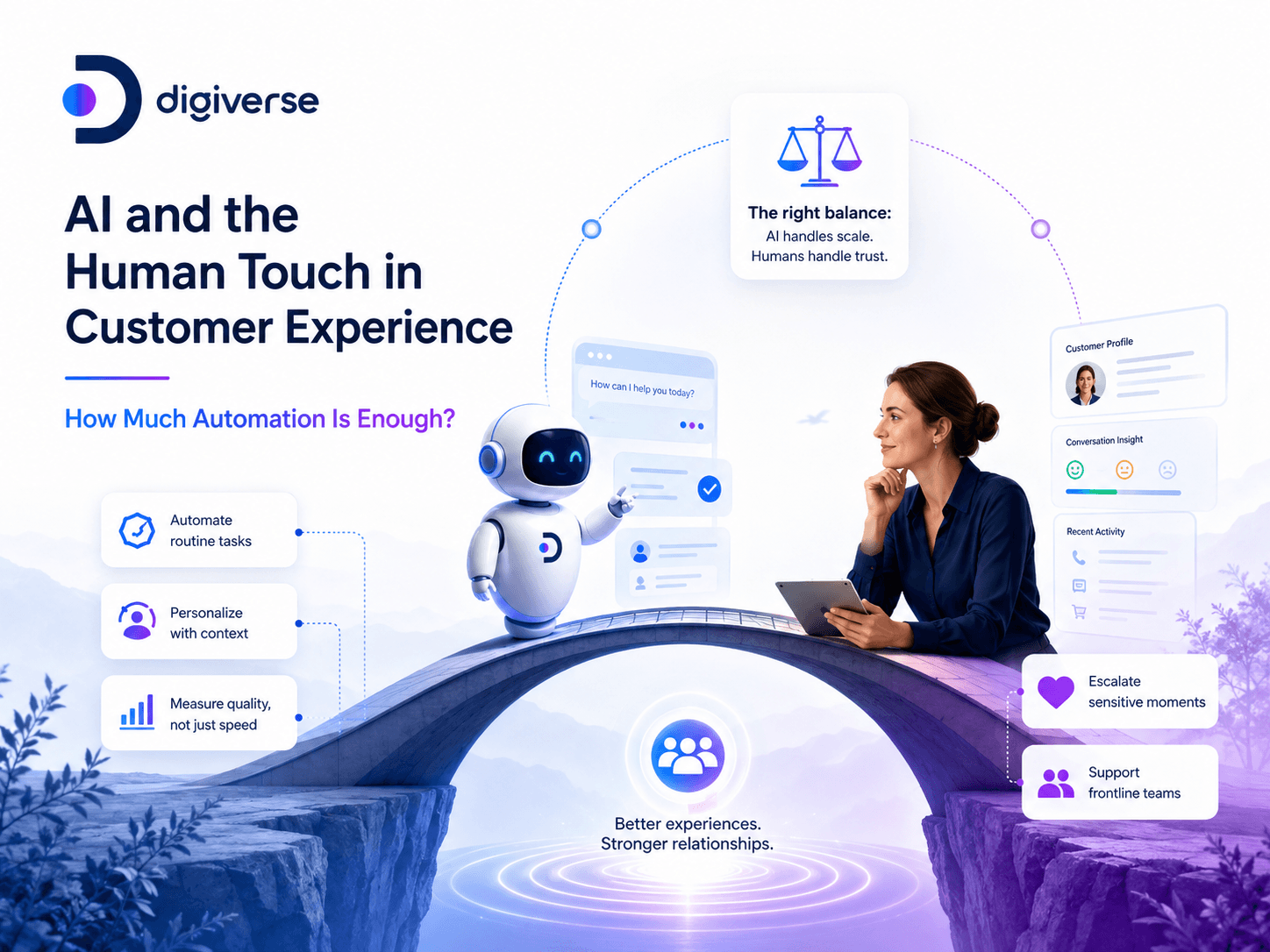
At Digiverse, we believe AI in customer experience should be used as an intelligent support layer, not as a total replacement for humans.
AI is best suited for tasks that are repetitive, data-rich, and carry low emotional risk. Humans are essential when the situation requires empathy, judgment, creativity, negotiation, or exception handling. A robust CX system should clearly define roles:
-
AI: Helps identify signals, provides fast responses to simple queries, summarizes info for staff, suggests follow-up steps, and automates basic journeys.
-
Humans: Help understand nuances, handle sensitive situations, build trust, make decisions when data is ambiguous, and refine the system when the experience feels “off.”
It is not about maximum automation; it is about automating the right things.
The Framework: 5 Principles for Balancing AI and Humans
-
Automate repetition, not empathy: AI is excellent for repetitive questions and structured tasks. Situations requiring emotional support should never be handled solely by automated systems.
-
Design clear handoff points: One of the worst experiences is being trapped in a chatbot loop. Businesses must establish clear “trigger points” for a handoff to a human—such as repetitive inquiries, angry language, refund requests, or when AI confidence scores are low.
-
Personalize based on context: Data tells you what a customer bought or clicked, but context tells you if they are in the research phase, ready to buy, or experiencing a service issue.
-
Use AI to empower frontline staff: AI shouldn’t just interact with customers; it should support agents by summarizing interaction history, suggesting responses, flagging priority customers, and aggregating common feedback.
-
Measure experience quality, not just response speed: If you only measure speed, you optimize for the wrong outcome. Measure issue resolution rates, customer satisfaction scores (CSAT), customer effort scores (how often they repeat info), and successful handoff rates.
Implications for Businesses in Vietnam
Many Vietnamese businesses are starting to integrate AI, chatbots, and CRM into their CX. This is a positive direction, especially as customer volumes grow. However, without a systematic approach, it can backfire. A fast chatbot that misunderstands the prompt creates frustration; an overactive automated messaging sequence leads to churn.
Vietnamese businesses should adopt a practical approach: automate simple inquiries first, use AI to support—not replace—your team, design clear human-handoff protocols, link your CRM to the customer journey, and measure the quality of resolution rather than just the number of messages processed.
Self-Assessment Checklist
-
[ ] Does the business classify which touchpoints should be automated and which need human intervention?
-
[ ] Do the chatbot/automated systems have clear handoff points to a human?
-
[ ] When a handoff occurs, does the customer have to explain everything from the beginning?
-
[ ] Does the CRM have enough data to understand which stage the customer is in?
-
[ ] Is AI being used to assist the frontline team?
-
[ ] Does the business measure the quality of problem resolution?