Introduction: A Misconception About CRM
Many businesses have implemented CRM systems, but not all of them unlock their true potential.
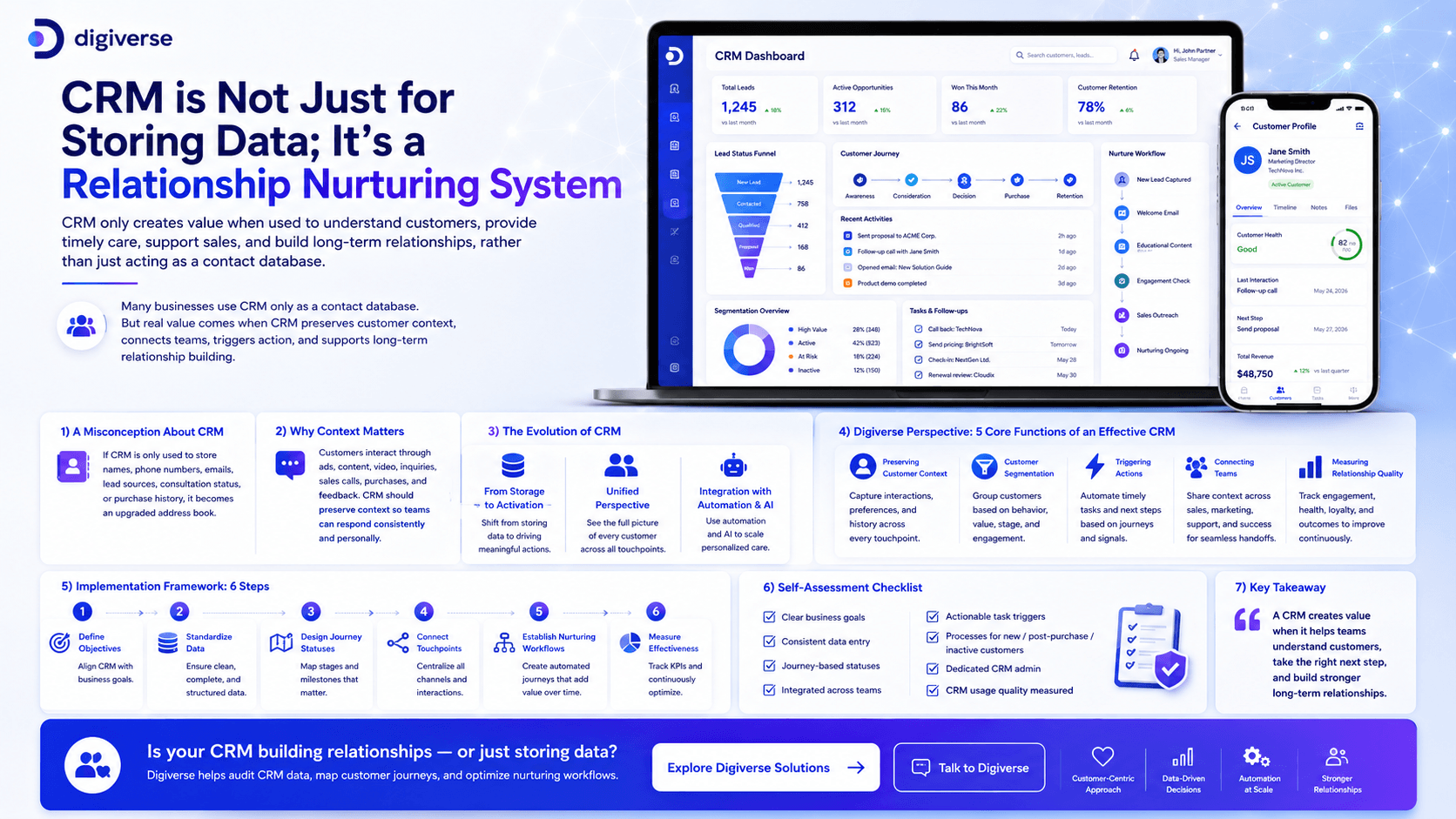
Often, CRM is used merely to store names, phone numbers, emails, lead sources, consultation statuses, or purchase histories. While this information is necessary, it is insufficient. If a CRM is viewed only as a storage space, it quickly becomes an “upgraded address book.”
When a CRM lacks proper updates, integration with the customer journey, or actionable workflows, the data sits idle. When marketing, sales, and customer service teams work in silos, the customer experience remains fragmented. A CRM should not only answer “who is the customer?” but also “where are they in their journey, how have they interacted, what do they need, and who is responsible for the next step?”
Why Context Matters
Modern customers do not interact with a business through a single touchpoint. They see ads, read content, watch videos, send inquiries, talk to consultants, make purchases, and provide feedback.
Without a clear relationship management system, businesses lose context. Marketing teams remain unaware of which leads sales have handled, while sales teams lack visibility into content engagement. Customers are forced to repeat themselves, and existing clients often receive messages meant for prospects. An effective CRM preserves this context, enabling teams to provide consistent, timely, and personalized care.
The Evolution of CRM
- From Storage to Activation
Modern CRMs go beyond data collection. They must categorize customers, track relationship status, record interaction history, trigger nurturing journeys, prioritize sales leads, alert teams to churn risks, and identify segments for reactivation.
- Unified Perspective
Marketing, Sales, and Customer Service often view customers through different lenses. A CRM should serve as the “single source of truth,” aligning these departments so they share the same understanding of the customer’s needs, history, and current status.
- Integration with Automation and AI
A CRM is most powerful when connected to marketing automation, chatbots, email, social inboxes, and AI. Whether it’s automatically triggering a welcome sequence, using AI to summarize interaction history for sales calls, or flagging negative feedback, the CRM acts as the core of the growth engine.
Digiverse Perspective: 5 Core Functions of an Effective CRM
- Preserving Customer Context: Storing more than just contacts—capturing interactions, needs, and behaviors.
- Customer Segmentation: Differentiating between new leads, prospects, existing buyers, and high-value or inactive customers.
- Triggering Actions: Clearly defining next steps, responsibilities, and timelines for teams.
- Connecting Teams: Eliminating gaps in the customer experience between departments.
- Measuring Relationship Quality: Evaluating conversion rates, retention, and long-term customer value.
Implementation Framework: 6 Steps to Using CRM Correctly
- Step 1: Define Objectives: Are you managing leads, supporting sales, or nurturing post-purchase relationships? Define your “why.”
- Step 2: Standardize Data: Ensure mandatory fields, customer statuses, and source tracking are consistent across the organization.
- Step 3: Design Statuses Based on the Journey: Map out the stages (e.g., New, Consulting, Considering, Purchased, Churn Risk) so the team knows exactly what to do next.
- Step 4: Connect Touchpoints: Integrate your website, forms, chatbot, and social inboxes with the CRM.
- Step 5: Establish Nurturing Workflows: Automate follow-ups, re-engagement tasks, and post-purchase care to ensure no lead is left behind.
- Step 6: Measure Effectiveness: Track metrics like lead processing time, conversion rates, and data quality to ensure the system creates real value.
Implications for Businesses in Vietnam
In Vietnam, many businesses struggle with CRM adoption—some use it only for data entry, while others keep sales data in disconnected files. To improve, start simple: standardize customer statuses, ensure data consistency, and connect the CRM to at least a few critical touchpoints. The goal isn’t complexity; it’s about understanding the customer better and acting correctly.
Self-Assessment Checklist
- [ ] Does the CRM serve clear business goals?
- [ ] Is data entry consistent?
- [ ] Do statuses accurately reflect the customer journey?
- [ ] Is the CRM integrated across Marketing, Sales, and Support?
- [ ] Does the system trigger actionable tasks?
- [ ] Are there clear processes for new, post-purchase, and inactive customers?
- [ ] Is there a dedicated administrator for the CRM?
- [ ] Do you measure the quality of CRM usage?
If you answered “not sure” to many of these, your CRM may currently be just a storage file rather than a relationship-nurturing system.