Introduction: From Information to Activation
Today, businesses have more customer data than ever before—from ads, websites, and social media to CRM, sales transactions, and customer support logs. However, having data does not mean understanding the customer.
A dashboard might show many metrics, but no one knows the next step. A CRM might store vast amounts of information, but teams fail to use it for personalized care. A weekly report may be updated regularly, but optimization decisions are still made based on intuition.
The problem is not a lack of data; it is that the data has not been transformed into action. Data only becomes valuable when it answers three critical questions: Where is the customer in their journey? What do they need next? And how should the business act?
Why This Matters
In the digital environment, customers leave a trail of signals: the content they view, their interaction with emails, their inquiries, their purchase history, and their silence.
If these signals are trapped in static reports, they lose their potential. A customer researching a specific solution needs expert consultation; a first-time buyer needs onboarding; an inactive customer needs re-engagement; a disgruntled customer needs immediate resolution. Data shouldn’t just help you look back; it should help you act correctly in the present.
The Shift in Data Role
- From Reporting to Operations
Previously, data was used for retrospectives: “How did the campaign perform?” or “What was the revenue?” Today, data must drive daily operations. It should trigger: “Who handles this new lead?”, “What is the next step for this high-intent prospect?”, and “Should we change the message for this low-performing segment?”
- Bridging the Silos
When marketing, sales, and support departments operate on disconnected data, the customer experience becomes fragmented. A customer might have messaged on Facebook, but the sales team is unaware. They might have already purchased, yet they still receive “new prospect” ads. Disconnected data creates a disconnected experience.
- AI Requires High-Quality Data
AI is a powerful tool for predicting behavior and suggesting actions, but it is only as good as its inputs. If data is siloed, incomplete, or lacks context, AI will produce inaccurate recommendations. Organizing data is the prerequisite for leveraging AI effectively.
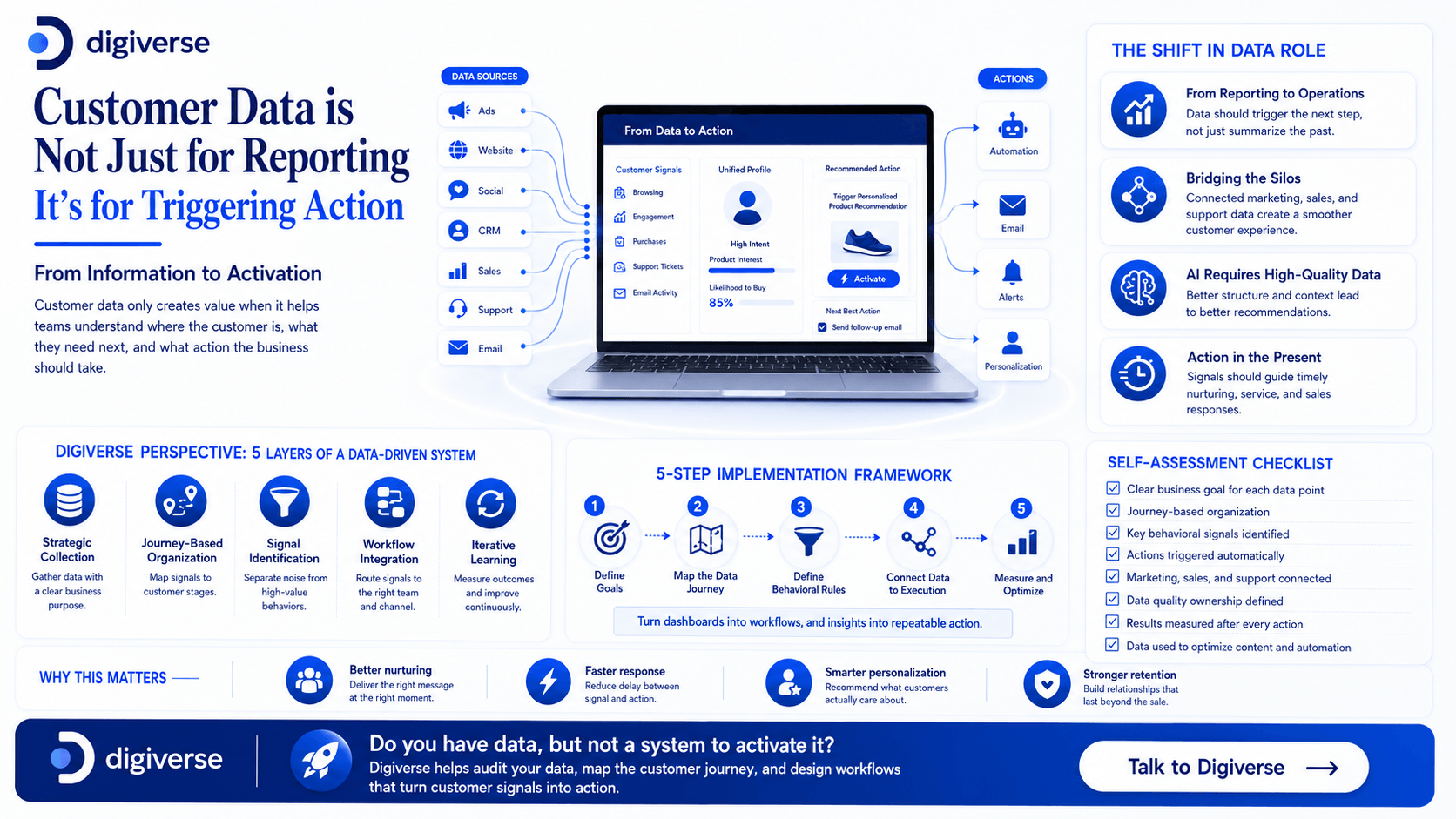
Digiverse Perspective: The 5 Layers of a Data-Driven System
- Strategic Collection: Only gather data that serves a specific business purpose.
- Journey-Based Organization: Map data to the customer’s stage (Awareness, Consideration, Purchase, Post-Purchase, Inactive).
- Signal Identification: Distinguish between noise and high-value behavioral signals that require intervention.
- Workflow Integration: Ensure every signal automatically alerts the right team via the right channel.
- Iterative Learning: Measure the outcome of every action to refine and improve the process.
Implementation Framework: 5 Steps to Turn Data into Action
- Step 1: Define Goals: Start with the “why.” Does the data help increase conversions, support post-purchase care, or facilitate reactivation?
- Step 2: Map the Data Journey: Identify where signals originate, where they are stored, who receives them, and where the gaps are.
- Step 3: Define Behavioral Rules: Classify signals (e.g., Interest vs. Readiness vs. Risk). Each category must have a defined follow-up action.
- Step 4: Connect Data to Execution: Move beyond dashboards. Use marketing automation to trigger emails, tasks for the sales team, or alerts for customer service based on real-time behavior.
- Step 5: Measure and Optimize: Track whether your actions actually improved results (e.g., higher conversion rates, shorter response times, or better retention).
Self-Assessment Checklist
- [ ] Do you know what specific business goal each data point serves?
- [ ] Is your data organized according to the customer journey?
- [ ] Have you identified key behavioral signals for your business?
- [ ] Does the system automatically trigger actions when signals occur?
- [ ] Are marketing, sales, and support data sources connected?
- [ ] Is there a clear owner for data maintenance and quality?
- [ ] Do you measure results after every triggered action?
- [ ] Is data used to optimize content and automation?
If you answered “not sure” to many of these, you may have data, but you lack the system to turn that data into growth.