Introduction: The Misconception of Replacement
Chatbots have become ubiquitous in customer experience. Whether on websites, Facebook, or messaging apps, businesses use them to answer questions about products, pricing, order status, or services. The goal is simple: respond faster and reduce the burden on support teams.
However, a chatbot should never be viewed as a full replacement for human personnel. Poorly designed chatbots leave customers feeling trapped, provide generic answers, offer no path to a human representative, lose interaction context, and frustrate users by trying to solve complex issues they aren’t equipped for.
An effective chatbot doesn’t need to answer everything. It needs to know its specific role in your customer experience ecosystem.
Why This Matters
Customers expect lightning-fast responses, but they also demand accurate understanding. A fast answer that misses the mark is worse than a slightly delayed response from a human.
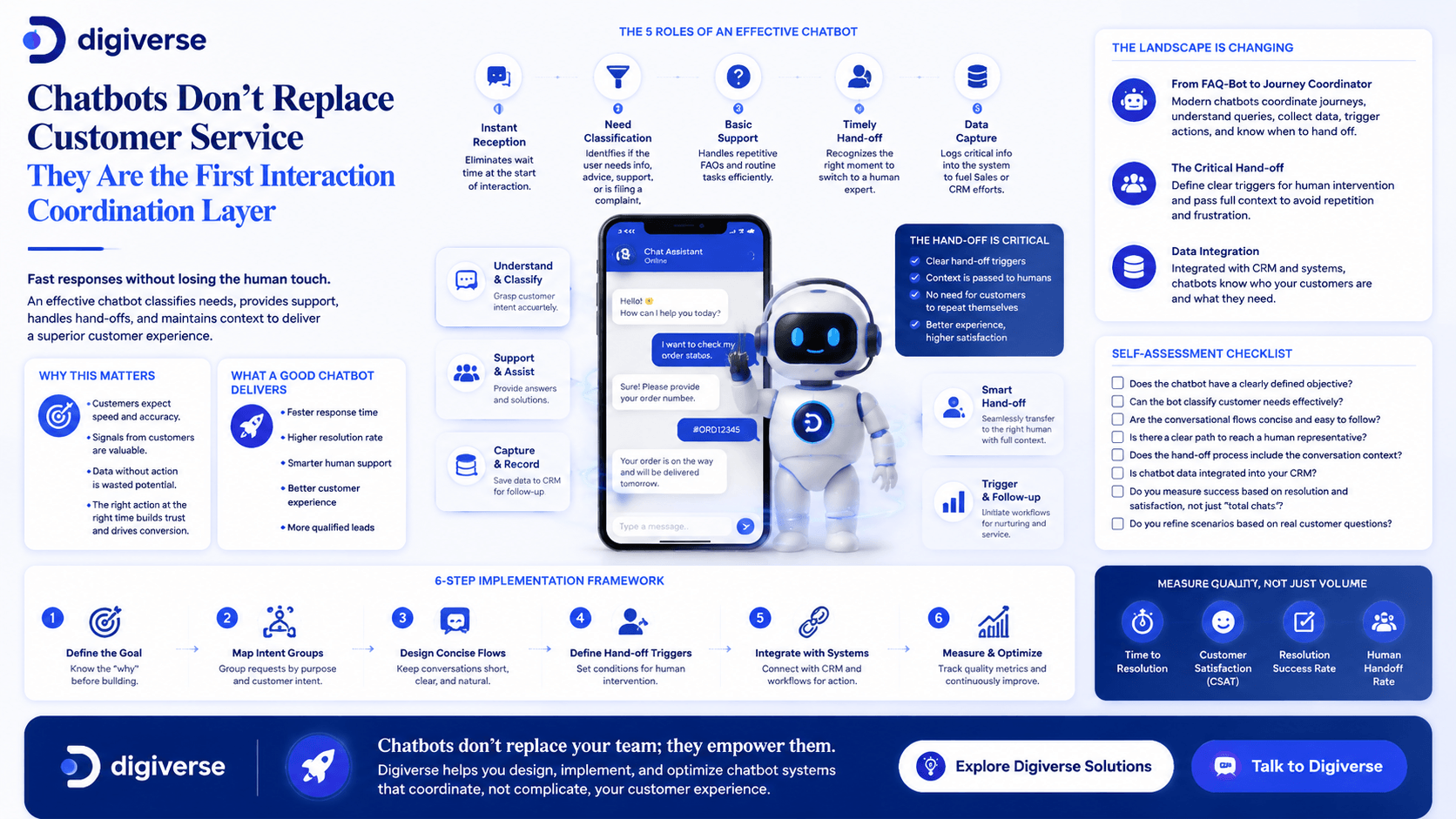
In a modern ecosystem, the chatbot serves as the First Interaction Coordination Layer. It greets the customer, classifies their intent, answers basic FAQs, collects initial information, suggests relevant content, checks statuses, and—crucially—routes requests to the right person while preserving the conversation context. This approach enables speed without sacrificing the human element.
The Changing Landscape
- From FAQ-Bot to Journey Coordinator: Early chatbots were glorified static menus. Modern chatbots must coordinate journeys: understanding the query, collecting necessary data, storing it in the CRM, knowing when to alert a human, and triggering follow-up nurturing sequences.
- The Critical Hand-off: The “human escape hatch” is the most vital feature. Businesses must define clear hand-off triggers: repeated failures to resolve an issue, expressions of frustration, requests for high-value consultations, or complex complaints. Crucially, the system must hand over the context—what the customer asked and what the bot already answered—so the customer doesn’t have to repeat themselves.
- Data Integration: A chatbot is only as smart as the data it accesses. Without CRM integration, it doesn’t know who the customer is. Without interaction history, it can’t maintain continuity. Without sales/support integration, leads are lost and complaints go unheard.
Digiverse Perspective: The 5 Roles of an Effective Chatbot
- Instant Reception: Eliminating wait times at the start of an interaction.
- Need Classification: Identifying if the user needs info, advice, support, or is filing a complaint.
- Basic Support: Handling repetitive FAQs and routine tasks efficiently.
- Timely Hand-off: Recognizing the precise moment to switch to a human expert.
- Data Capture: Logging critical info into the system to fuel Sales or CRM efforts.
Implementation Framework: 6 Steps to Design Your Chatbot
- Step 1: Define the Goal: Is it lead generation, post-purchase support, or FAQ deflection? Your goal dictates your data flow.
- Step 2: Map Intent Groups: Group requests into categories like “Product Info,” “Pricing,” “Order Tracking,” “Technical Support,” and “Request to Speak to Human.”
- Step 3: Design Concise Flows: Keep interactions short, easy to understand, and avoid making the customer feel like they are taking a test.
- Step 4: Define Hand-off Triggers: Define conditions for human intervention (e.g., negative keywords, customer value, repeated failures, or specific complex topics).
- Step 5: Integrate with CRM/Workflow: Ensure the bot feeds info into your operational system. If the bot generates a lead, it goes to Sales. If it receives a complaint, it alerts Support.
- Step 6: Measure Quality, Not Just Volume: Track success rate, time to resolution, abandonment rate, and customer satisfaction (CSAT) after the bot interaction.
Implications for Businesses in Vietnam
In Vietnam, customers are highly active on Facebook, Zalo, and E-commerce platforms. Chatbots are powerful tools to handle the high volume of messages. However, many businesses here suffer from “rigid script syndrome”—where the bot is unable to save history or connect to a real person. To succeed, start small: build the bot to handle your top 3 most common queries and prioritize a seamless hand-off to your human team for everything else.
Self-Assessment Checklist
- [ ] Does the chatbot have a clearly defined objective?
- [ ] Can the bot classify customer needs effectively?
- [ ] Are the conversational flows concise and easy to follow?
- [ ] Is there a clear path to reach a human representative?
- [ ] Does the hand-off process include the conversation context?
- [ ] Is chatbot data integrated into your CRM?
- [ ] Do you measure success based on resolution and satisfaction, not just “total chats”?
- [ ] Do you refine scenarios based on real customer questions?
If you answered “not sure” to many of these, you are running an auto-responder, not an interaction coordination layer.