Opening Statement
After the initial phase where businesses experimented with AI for content creation, data summarization, or ideation, a new concept is gaining traction: Agentic AI.
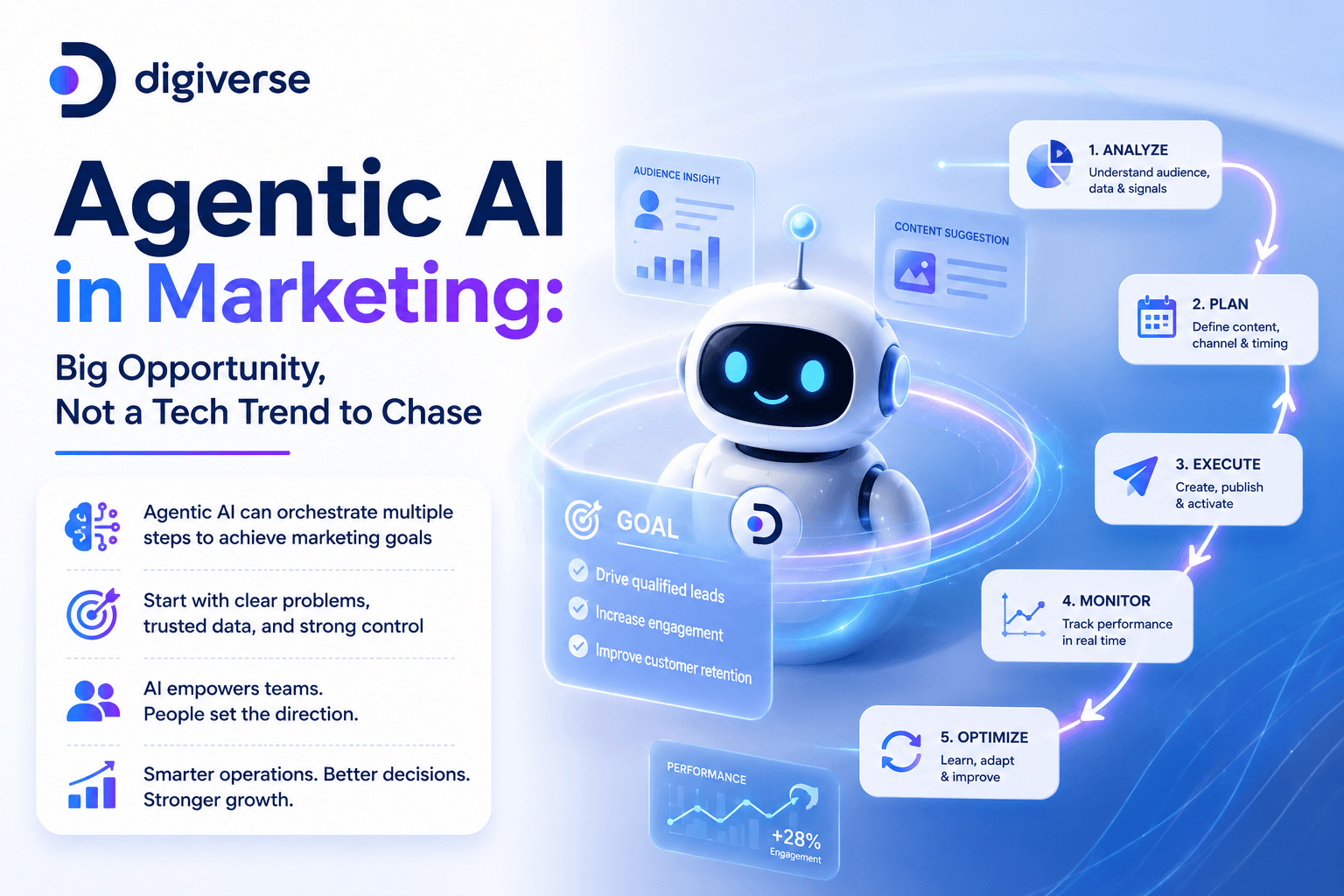
Simply put, Agentic AI refers to AI systems capable of executing a sequence of steps to achieve a specific goal, rather than just responding to a single prompt. For example, while a traditional AI tool might help write an email, an Agentic AI system acts like an assistant that can analyze customer segments, propose content, determine the optimal send time, track feedback, and suggest the next best action.
For marketing, Agentic AI opens up significant possibilities: orchestrating parts of the content pipeline, assisting in customer care, detecting data signals, optimizing campaign performance, and coordinating across multiple tools.
However, precisely because it sounds so appealing, businesses must be cautious. Not every team is ready. Not every process should be AI-orchestrated. Not every data set is reliable. Not every marketing decision can be automated. Not every Agentic AI experiment will yield clear business value.
The opportunity is real. But chasing the hype without a robust framework will only lead to wasted costs, increased risk, and operational complexity.
Why This Matters
Marketing is inherently a multi-step process: from ideation to content, distribution, measurement, and optimization. From lead generation to nurturing, and from market signals to strategy adjustments.
Agentic AI seems perfectly suited for this, as it manages complex workflows better than AI that only responds to isolated queries. However, these very workflows carry significant risks. If the goal is poorly defined, the AI might optimize in the wrong direction. If the data is flawed, the AI will trigger the wrong actions. Without rigorous control, AI can generate off-brand content or make inappropriate decisions.
Therefore, Agentic AI should not be viewed as “magic technology.” It should be viewed as a new layer of capability that must be integrated into your operating system with responsibility.
What is Changing?
-
From Answering to Acting: In the early stages, teams used AI to “ask and receive”—writing snippets, summarizing reports, or generating headlines. With Agentic AI, the expectation shifts: the AI now coordinates multiple steps toward an outcome. This potential is high, but so is the risk. When AI moves from drafting to executing, the need for human oversight becomes even more critical.
-
Process Before Automation: Agentic AI only functions well when processes have clear objectives and conditions. If a business hasn’t defined what a “quality lead” is, or lacks a clear brand voice or a defined customer journey, AI will struggle to be effective. Agentic AI cannot fix a broken process; it can only make a good process run smarter.
-
Value Over Hype: One of the greatest risks of new technology is implementing it just to avoid being “left behind.” The real questions should be: What specific problem is this solving? Is it important? Can the value be measured? Can we control the risks? Is it scalable after testing?
The Digiverse Perspective
At Digiverse, we view Agentic AI as an evolution of your Digital Growth Operating System, not as a standalone tool.
It should only be deployed when the business has four minimum foundations in place:
-
Clear Objectives
-
Reliable Data
-
Clearly Defined Processes
-
Defined Control and Measurement Mechanisms
If any of these are missing, prioritize standardization before granting AI more autonomy. We do not see Agentic AI as a replacement for the marketing team. Rather, AI assists the team by handling repetitive tasks, detecting signals faster, recommending data-driven actions, and connecting operational steps. Humans remain the architects—setting goals, overseeing quality, and steering the strategy.
Practical Use Cases to Start With
-
Signal Summarization & Action Suggestions: Use AI to aggregate data from multiple sources and flag items for review: unusual content performance, high-priority customer segments, or trending social media topics.
-
Controlled Content Workflows: AI can assist in receiving briefs, suggesting angles, drafting outlines, checking brand tone, and summarizing post-publication performance. However, human review and approval remain non-negotiable.
-
Journey-Based Customer Care: Suggesting the next best action based on customer behavior—nurturing leads, post-purchase follow-ups, or re-engaging inactive customers.
-
Campaign Optimization: Identifying signals in live campaigns—such as which messages resonate or which landing pages have high drop-off rates—and suggesting optimizations. In the early stages, AI should only suggest; do not allow AI to automatically adjust budgets or core messaging without human authorization.
-
Cross-Team Coordination: Reducing silos by summarizing leads for sales teams, notifying managers of pending requests, or feeding advertising signals back into growth reports.
The 5-Step Framework for Safe Experimentation
-
Select a High-Value, Low-Risk Problem: Start with specific tasks like automating report aggregation, drafting internal content, or prioritizing leads for sales.
-
Document the Process: Clearly define inputs, AI’s scope of work, expected outputs, quality standards, and “human-in-the-loop” intervention points.
-
Set Action Limits: Differentiate between tasks where AI can only suggest, tasks where AI can draft, and tasks where AI can execute after approval.
-
Measure Actual Value: Track metrics like time saved, manual steps reduced, decision-making speed, and feedback quality.
-
Scale Incrementally: Only expand once processes are stable, data is reliable, the team is trained, and risks are managed.
Implications for Businesses in Vietnam
Many Vietnamese enterprises are already experimenting with AI in content, customer care, and advertising. This is a solid foundation. However, before rushing into Agentic AI, assess your readiness: Are your processes documented? Is your data clean? Is there a clear quality standard?
You do not need complex solutions to start. Begin with tangible applications: summarizing customer feedback, assisting the sales team with lead intelligence, or alerting the team to anomalous campaign metrics.
Self-Assessment Checklist
-
[ ] Does the business have a specific, measurable problem for AI to solve?
-
[ ] Is the current process clearly mapped out?
-
[ ] Is the input data reliable?
-
[ ] Are there clear rules on what AI is allowed to do vs. what it isn’t?
-
[ ] Is there a dedicated human reviewer for AI-generated outputs?
-
[ ] Is there a framework to measure the value of the experiment?
Call to Action
If your business is ready to take AI to the next level but isn’t sure where to begin, Digiverse can help you identify suitable use cases, design experimental processes, and build a value-measurement framework before you scale.
[Explore Digiverse Solutions] | [Talk to Digiverse]